
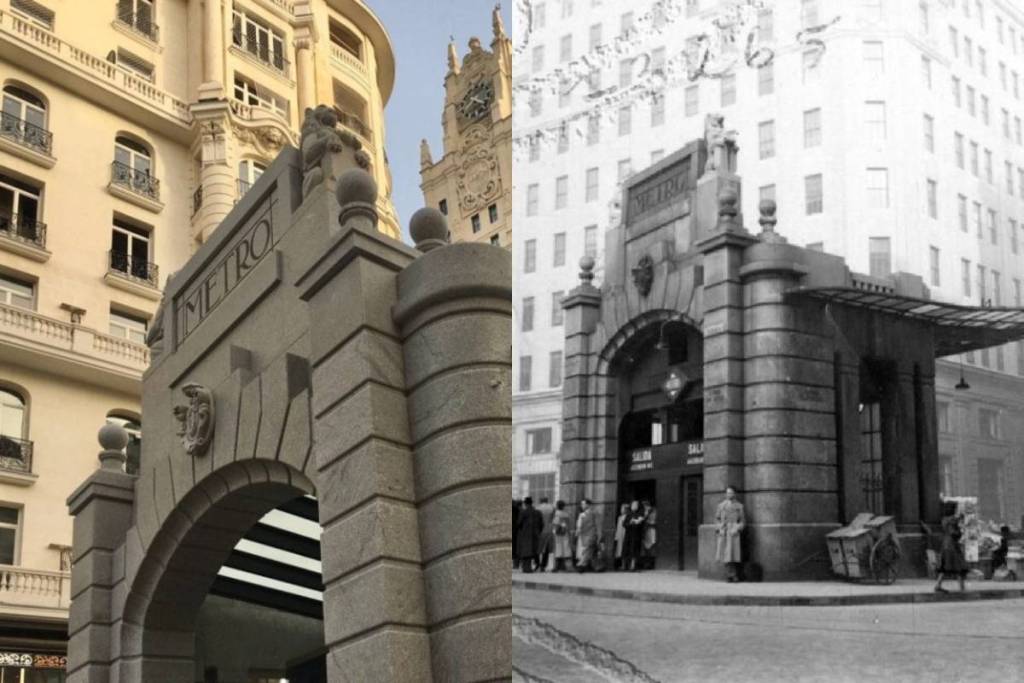

The Madrid Metro has grown older. There is only one person in the world who was alive (Ethel Caterham, aged 117 years and 46 days) when the first trip aboard the subway took place. October 17 marks the 107th anniversary of the Madrid Metro’s opening. Its first line had just eight stations between Cuatro Caminos and Sol, and some of them have even changed names since then.
The Madrid Metro is about to add another year to its already long history. October 17 marks the 107th anniversary of the opening of the first line, which began operating in 1919 on a scale that’s hard to compare to that of the current network: just eight stations and less than four kilometers between Cuatro Caminos and Sol (there are currently 302 stations).
Much of that original route remains part of today’s Line 1, although the names that appear on current maps are not exactly the same as those encountered by the first passengers.
From Martínez Campos to Iglesia and from Hospicio to Tribunal

The route began at Cuatro Caminos and continued through Ríos Rosas—two names that have remained unchanged for over a century. Next came Martínez Campos (now known as Iglesia) and Chamberí.
From there, the trains continued on to Glorieta de Bilbao—now simply Bilbao; Hospicio, which was renamed Tribunal; and Red de San Luis, now known as Gran Vía. The final stop was Puerta del Sol, which we now know as Sol.
In other words, of the eight original stations, four have retained their names almost entirely—Cuatro Caminos, Ríos Rosas, Chamberí, and Sol—while the others have gradually changed their names over the decades.
The only one of the eight stations that is no longer served by trains
Seven of those eight stations are still in service today. The exception is Chamberí, which closed to the public as a station in 1966, when the trains and platforms began to be expanded.