
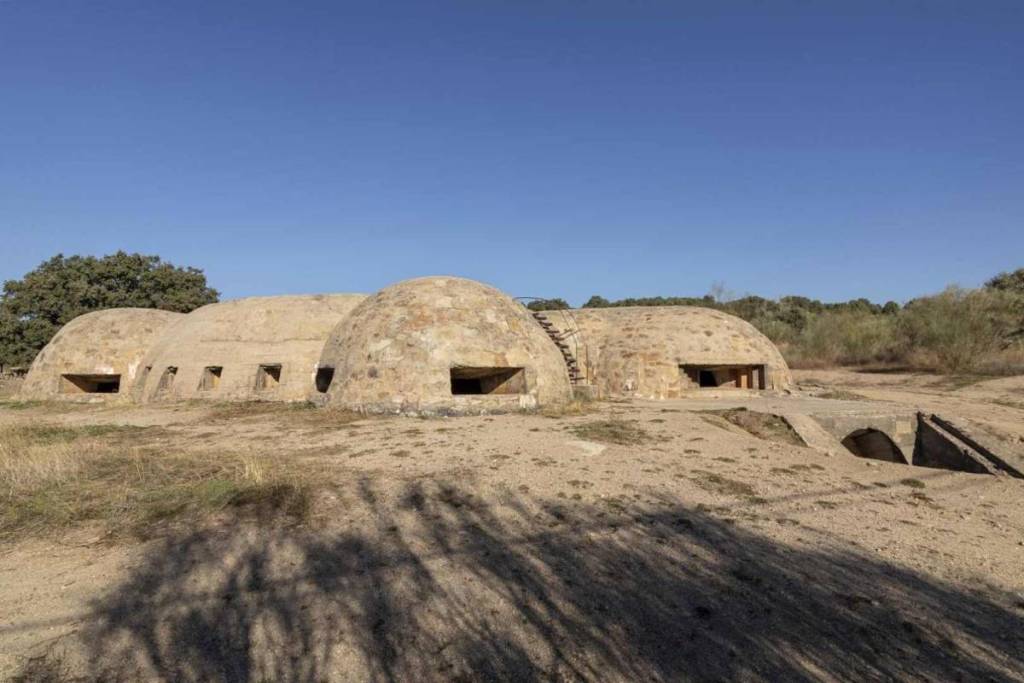

About 50 kilometers from Madrid, a concrete fortification offers a glimpse into one of the most recent chapters in Spanish history. It is Blockhaus-13, located in Colmenar del Arroyo, a bunker built during the final months of the Civil War that today is one of the sites related to the conflict open to visitors in the Community of Madrid.
According to the Spanish Association of Friends of Castles, construction was brief: work began in late 1938 and was completed in February 1939—a span of about two months. The result was a structure measuring approximately 160 square meters, organized around a main body ten meters in diameter and four smaller positions connected to it.
Recommended Articles
 A show featuring 500 drones will light up the sky over downtown Madrid: the Christmas lights ceremony kicks off this weekend
 Madrid’s sky will host its biggest Christmas spectacle yet with more than 2,000 drones: it’ll be three shows in one, featuring activities and food trucks at the Hipódromo de la Zarzuela
The bunker is located about two kilometers northeast of the town center of Colmenar del Arroyo, near kilometer 33.670 of the M-510 highway, which connects the town with Navalagamella. This proximity makes it possible to plan the visit as a walking tour from the town, covering a total distance of approximately four kilometers.
Why was it built after the Battle of Brunete?
To understand Blockhaus-13, we must go back to the stabilization of the front west of Madrid. Colmenar del Arroyo had been occupied by the rebel army in November 1936 and became a staging area for troops serving on the front lines. Two years later, commanders ordered the reinforcement of defenses along the region’s main roads.
The Battle of Brunete, which took place between July 6 and 25, 1937, is one of the most significant and bloodiest battles in the region. However, the bunker dates from a later phase: that of preparing positions capable of halting a possible new attack by the legitimate government and controlling the lines of communication with a small number of troops. This function explains both its location and its design.
Four observation posts to monitor the entire surrounding area
The uniqueness of Blockhaus-13 is evident in its floor plan. The main structure, ten meters in diameter, connects to four other smaller chambers. Its embrasures—the openings designed for observing and firing from a protected position—allowed for control of the surrounding terrain in all directions.
The structure covers about 160 square meters and rises just over two meters above ground level. It is not a particularly tall structure; its significance lies in the layout of its spaces, the use of reinforced concrete, and its ability to organize defense from various interconnected positions. The Community of Madrid considers it one of the most outstanding examples of Civil War military architecture in the region and has designated it a Site of Cultural Interest.
The name also refers to an earlier defensive tradition. The German term “blockhaus” was adopted by the French during World War I to describe concrete structures that emerged after the Western Front had stabilized. In Colmenar del Arroyo, this model was adapted to meet the surveillance and defense needs of the roads along the Madrid front.
The only one completed out of a network of 18 fortlets
The number 13 is not arbitrary, as the bunker was part of a broader defensive network. The Community of Madrid notes that 18 fortifications of this type were initially planned and that, although several were under construction by the end of December 1938, only Blockhaus-13 was ever completed.
The construction was carried out by the 2nd Company of the 7th Sapper Battalion. This is one of the aspects that makes the site particularly valuable: in addition to preserving the structure, specific details are known about who built it and the context in which it was designed. The end of the war, on April 1, 1939, led to the abandonment of work on the other fortifications.
According to the Spanish Association of Friends of Castles, the bunker was never actually used in combat.