
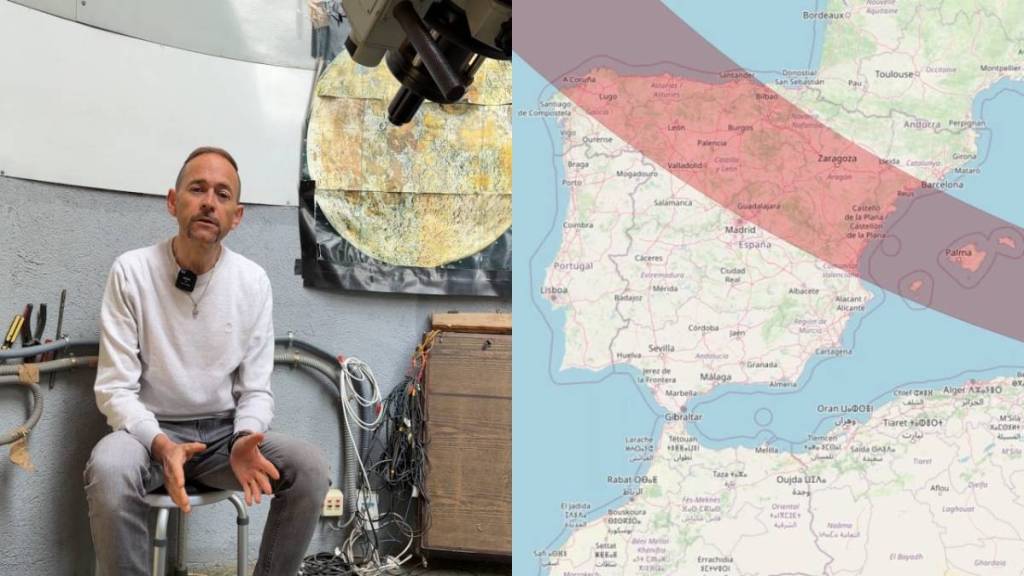

The Iberian Peninsula will once again be plunged into darkness in broad daylight for the first time in over a century. On August 12, 2026, at sunset, a total solar eclipse will be visible from the northern third of the peninsula—an astronomical phenomenon that usually forces enthusiasts to travel thousands of kilometers to inhospitable locations.
César González, a science communicator at the Madrid Planetarium, explains that around 8:30 p.m., the lunar disk will completely cover the Sun. This effect occurs because the Moon orbits the Earth at about 3,200 kilometers per hour while our planet also rotates. The rapid movement of both celestial bodies will cast a shadow that will swiftly cross northern and central Spain, creating what is known as the path of totality.
The path of totality in Spain
The lunar shadow will completely cover the Sun in several autonomous communities. The total phase will be fully visible in Galicia, Asturias, Cantabria, Castile and León, Navarre, and Aragon. The shadow’s path will also affect parts of Catalonia, the Valencian Community, and the Community of Madrid.
In certain locations situated along the center of this path—such as towns in the provinces of León, Soria, or Palencia—total darkness will last one minute and 43 seconds. To witness this peak phase, experts note that it’s worth traveling hundreds of kilometers into the path of totality.
During the partial phases, as well as in all areas outside the path where the Moon does not completely cover the Sun’s disk, it will be essential to observe the sky while always wearing protective eyewear.