


For decades, the Stella Pool was a dream out of reach for most Madrileños, who lived on the sidelines of the celebrities who swam in this club’s pool, its exclusive summer nights, and a legend that still lives on among the residents of Arturo Soria. Now, the former complex is undergoing a complete transformation. The historic swimming pool, with its rationalist lines and nautical theme, will disappear to make way for a Catholic school with capacity for around 1,000 students, scheduled to open at the start of the 2028–2029 school year.
The 8,400-square-meter site, located at the end of Arturo Soria, was acquired in December 2025 by the French congregation Union Chrétienne de Saint-Chaumond. The project will preserve the main building and the protected gardens but will completely alter the space formerly occupied by the swimming pool.
The swimming pool that defined an era
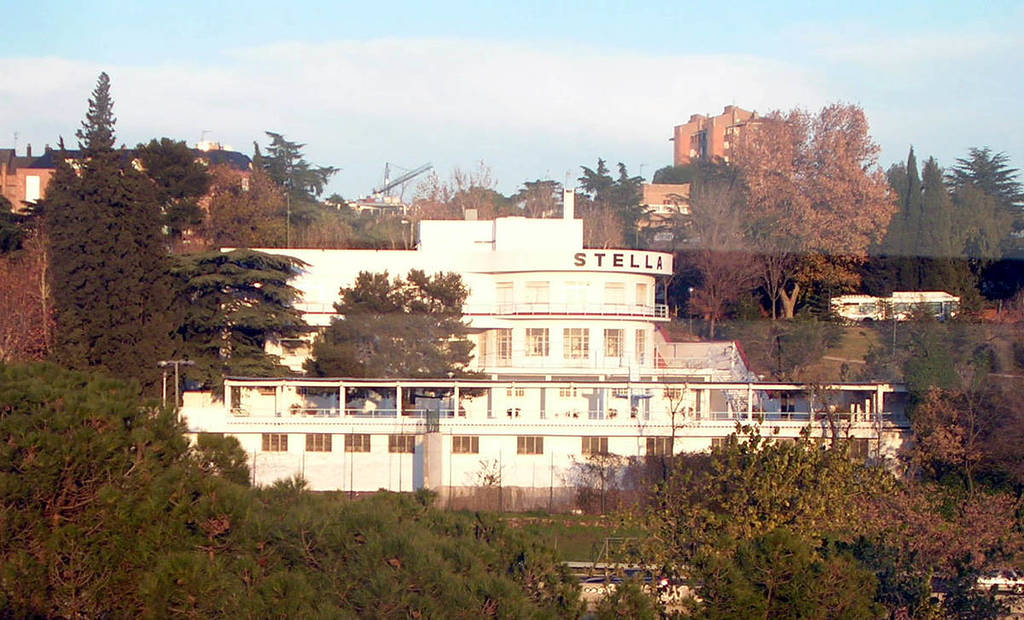
Club Stella was founded in 1947 on an elevated plot next to what is now the M-30 highway. Its rationalist design, featuring long horizontal lines, terraces, sunbathing areas, and a large swimming pool, made it one of the symbols of modern leisure in postwar Madrid.
The pool quickly gained fame. In the 1950s and 1960s, it was a gathering place for high society, artists, tourists, and curious visitors seeking a summer experience different from that of municipal pools or trips to the coast. The club became a trendy spot, associated with nightlife and a more open image of the city.
Among the stories that have been told for decades about this place is that of Ava Gardner, one of Hollywood’s greatest stars who lived in Madrid from 1953 to 1961. The actress frequented the capital’s nightlife and entertainment venues during those years, and her name became linked to the legend of “La Stella’s” revealing moment—one of the episodes that fueled the myth surrounding the place.
A protected building, an unprotected swimming pool
Club Stella closed its doors in 2006 and remained abandoned for nearly two decades. Despite this long period of deterioration, the main building retains Level 3 urban planning protection—partial or environmental in nature—while the gardens have Level 2 structural or volumetric protection.
This requires the new project to preserve the building’s exterior envelope and the character of the garden. The future school will utilize the existing structure to house some of the classrooms, the library, the administrative and administrative offices, as well as the cafeteria.
The pool, however, does not enjoy the same heritage protection. That is why its disappearance is inevitable under the current plan. The pool itself will be demolished and replaced by new structures, although the project aims to preserve its footprint: part of the old beach area and the pool’s hollowed-out space will be converted into a courtyard that will provide light and ventilation to several classrooms.
The school plans for female students to attend preschool and elementary school there before later transferring to its campus on Rodríguez Marín Street. Male students, on the other hand, will complete virtually their entire schooling at the new school, except for the last two grades, which will also be taught at Rodríguez Marín.
The project has been in the works for about a year, and construction will take at least two years. The congregation has already applied for a building permit, although the project still depends on the report from the Commission for the Protection of the Historical, Artistic, and Natural Heritage of the City of Madrid, as it involves a protected building and garden.
The Heritage Commission’s response is expected in September. If the schedule proceeds as planned, the school will open at the start of the 2028 school year.