
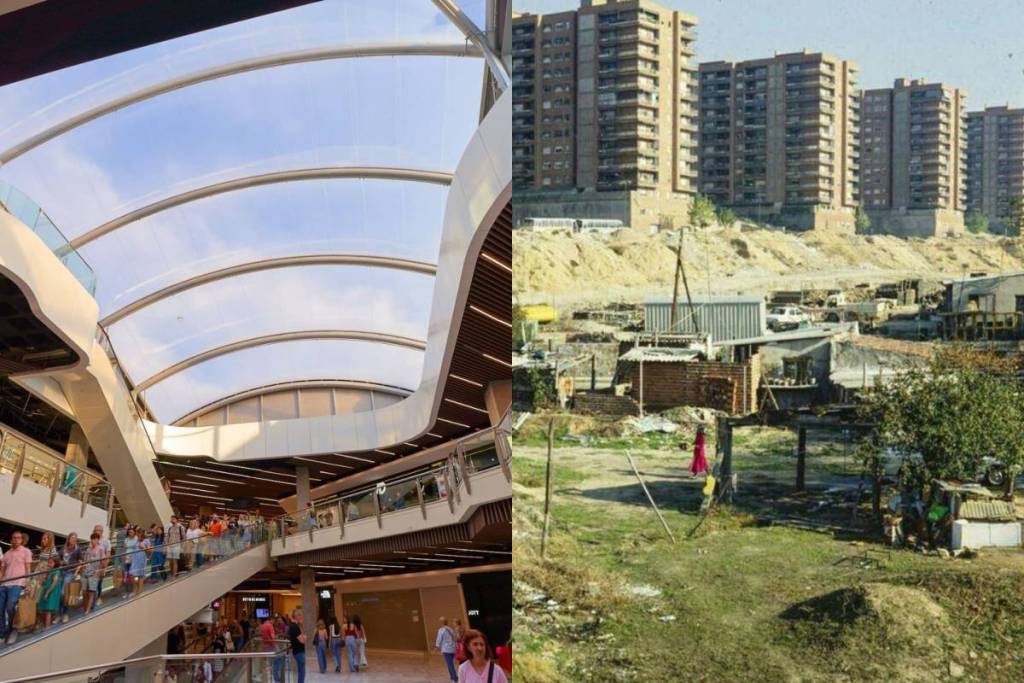

Just how important the La Vaguada shopping center is can be seen in the fact that its very existence has even warranted a novel. It was written by Fernando San Basilio and titled, precisely, *My Great Novel About La Vaguada* (2010). In it, an unemployed young man from Madrid dreams of writing a book about this place. Not many more novels have been written about it, but there have been news reports detailing its construction: residents perched on cranes, demonstrations, political disputes, and half a million visitors during its first four days of operation.
On October 24, 1983, Mayor Enrique Tierno Galván inaugurated Madrid-2, as the shopping center in the Pilar neighborhood was originally called. It was the first of its size in Madrid and one of the pioneers in Spain. Its arrival introduced a new way of shopping, strolling, and spending free time, but not everyone was willing to welcome it with open arms.
Seven years of protests against La Vaguada

To understand the neighborhood opposition, one must go back to the 1960s, when businessman José Banús built much of the Pilar neighborhood (not surprisingly, the neighborhoods along the M-30 are known by the businessman’s last name). The buildings went up very quickly, but as is often the case (and as is happening now), public services did not keep pace. There was a shortage of schools, health centers, sports facilities, and green spaces.
Residents had hoped that one of the last large available plots of land would be set aside for such infrastructure. However, the land ended up in the hands of a French developer who wanted to build a gigantic shopping mall.
In 1976, the “La Vaguada es nuestra” (La Vaguada Is Ours) movement was formed, which spent seven years trying to prevent its construction. There were demonstrations, tree-planting campaigns, and sit-ins next to the excavators.
As journalist Alfredo Pascual notes in a report published in El Confidencial, the conflict also put Tierno Galván’s city government on the ropes. Although the mayor had expressed his opposition to the project, canceling it would have entailed millions in compensation.
Public pressure succeeded in modifying part of the initial plans and setting aside land for public facilities, although not all of the urban planning provisions came to fruition.
From Protests to Half a Million Visitors
The shopping center’s design brought together architect José Ángel Rodrigo and Lanzarote-born artist César Manrique, known for his unique way of integrating nature and architecture.
La Vaguada incorporated elements that were unusual for a commercial space at the time: large skylights, gardens, waterfalls, abundant vegetation, and distinctive white sails on the roof. As Rodrigo explained to El Confidencial, many of these design choices were driven by practical needs, such as protecting the interior from heat and making the most of natural light.
Finally, the complex was inaugurated on October 24, 1983, with Tierno Galván leading a delegation of officials and business leaders. The next day it opened to the public, and expectations were exceeded.
According to a historical account by Vaguada.es, half a million people visited the shopping center during its first four days.
Among the original stores were Alcampo, C&A, Galerías Preciados, and McDonald’s. For many Madrileños, that visit marked their first encounter with a retail concept they had previously seen mainly in foreign films.