
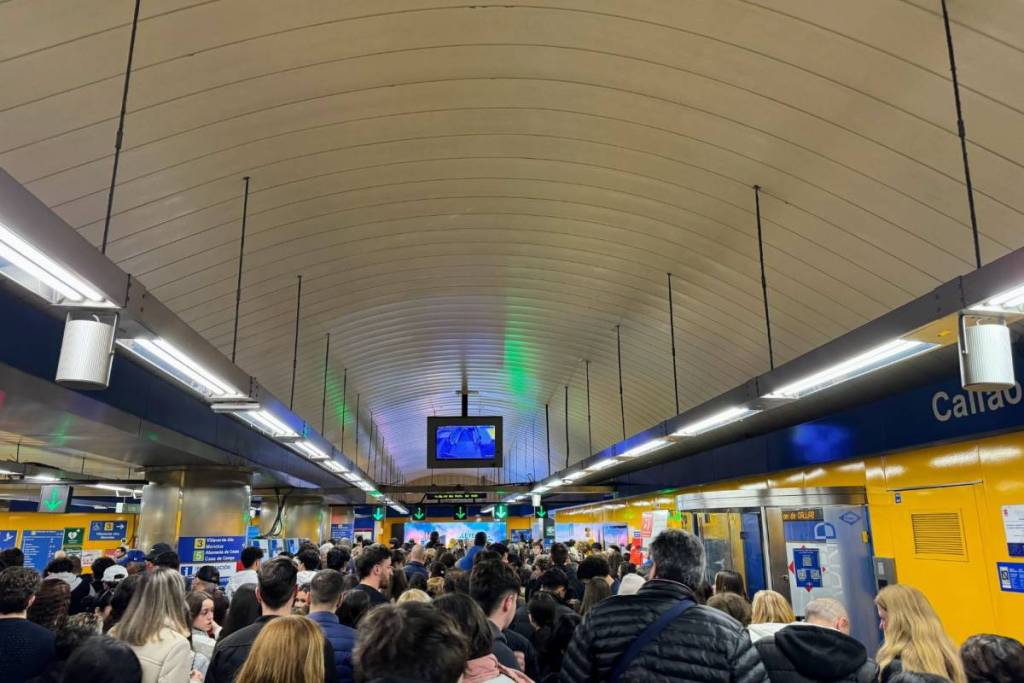

Madrid is facing three consecutive days of disruptions to public transportation. In addition to the Renfe train drivers’ strikes called by Semaf for today, Tuesday, November 10, and Thursday, November 12, there will be a general strike on Wednesday, November 11, which will also affect urban transportation and other public services.
This latest call for a strike covers the entire 24-hour period and, according to the Official Gazette of the Community of Madrid, has been announced by CCOO, UGT, and other labor unions. The demands of the general strike include wage increases and measures to facilitate access to housing, while the Semaf dispute centers on the fulfillment of commitments regarding rail safety.
Madrid Metro: Minimum service levels of 80% during peak hours and 50% during off-peak hours
The Madrid Metro does not anticipate any service interruptions due to the general strike on November 11. The Governing Council’s agreement, published in the BOCM on November 6, establishes a minimum service level of 80% of trains during peak hours and 50% during off-peak hours.
Even though the shutdown won’t be total, it’s very likely that crowds will be constant, since they occur even when the Metro is operating at 100% capacity. In addition, part of the A5 is closed due to construction, and heavy rains tend to increase the number of Metro riders.
Commuter Trains: 75% of Trains During Peak Hours

For the Semaf work stoppages on November 10 and 12, Renfe has announced minimum service levels of 75% during peak hours on the Cercanías commuter rail system and 50% during the rest of the day. Peak demand periods are from 6:00 a.m. to 9:00 a.m., 1:30 p.m. to 3:30 p.m., and 6:30 p.m. to 8:30 p.m. The same coverage percentages have been published for the general strike on Wednesday, November 11, on the Cercanías commuter rail network. However, in many cases, minimum service levels are not being met.
These are separate calls for strikes, although their effects will overlap over three days: Cercanías Madrid has warned of significant service disruptions and has recommended finding alternative ways to get around.
Healthcare and education: essential services, but no guarantee of normal operations
The general strike also affects Madrid’s public services, although regional minimum staffing levels aim to preserve essential services. In hospitals, staffing levels on Sundays and holidays will serve as the benchmark, along with medical staff on scheduled call and reinforcements in critical care units; the SUMMA 112 urgent and emergency care services must maintain the staffing levels outlined in their plans.
In education, the agreement provides for a minimum staff level to attend to students, with special consideration given to preschools and special education centers. These guarantees do not mean that all consultations, classes, or administrative procedures will proceed as usual; therefore, it is advisable to confirm with the respective school any appointments or activities scheduled for Wednesday.