
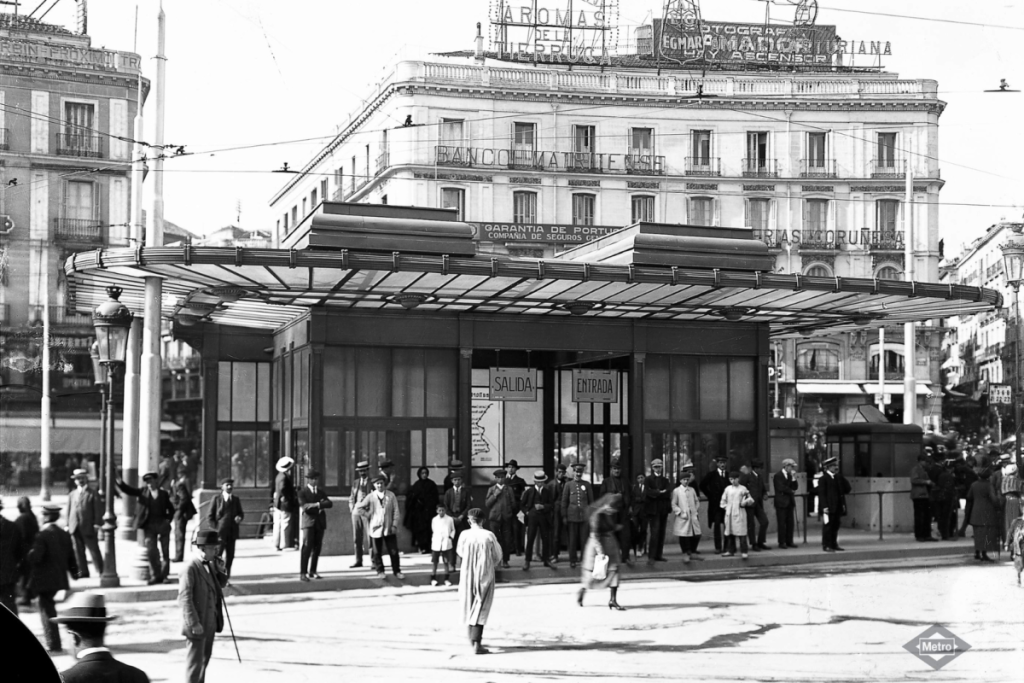

The Metro diamond, the Palacio de Cibeles, and the Círculo de Bellas Artes all share a common name: Antonio Palacios. Born in O Porriño, Pontevedra, in 1874 and died in Madrid in 1945, he was one of the architects who contributed most to transforming the capital during the first half of the 20th century. His work combined monumental buildings with everyday infrastructure: he not only reshaped the city’s skyline but also changed the way Madrileños accessed public transportation and recognized its stations.
His relationship with the subway began in 1917, when the company commissioned him to design and decorate stations and entrances. Palacios created the diamond logo that identifies the Metro—which today celebrates 106 years of operation—and defined much of the aesthetic of its early lines, from the interiors to signage and entrances. The tile cladding helped bring light into the underground spaces and reduce the feeling of confinement. Among his most notable projects were the pavilions at Sol and Gran Vía, designed to integrate the entrances into the urban landscape.
Antonio Palacios’s Madrid
His mark on the cityscape is equally recognizable. Together with Joaquín Otamendi, he designed the Palacio de Comunicaciones—now the Palacio de Cibeles and headquarters of the Madrid City Council—the former Hospital de Jornaleros de Maudes, and the Banco Español del Río de la Plata, known as the Edificio de las Cariátides and now home to the Instituto Cervantes. Although they were originally built for very different purposes, these buildings shared a monumental ambition and a layout designed to meet the needs of a city undergoing modernization.
The Círculo de Bellas Artes rounds out this overview of his most representative works. In 1919, the institution’s members selected his proposal—a building that embraced height and verticality to bring together cultural and artistic activities. The subsequent adaptation of many of his buildings to new uses explains the enduring relevance of his legacy: his buildings continue to house institutions, while the Metro’s symbol continues to guide travelers. Palacios thus left a recognizable identity both in the grand facades and in the small details of everyday life in Madrid.
Unfortunately, not all of Antonio Palacios’s legacy has survived. One of the greatest losses was the Hotel Florida, which opened in 1924 on Plaza del Callao: it had a marble façade and 200 rooms with private bathrooms, and during the Civil War it became a gathering place for writers and foreign correspondents. It was demolished in 1964 to make way for a Galerías Preciados department store, now occupied by El Corte Inglés.
The entrance pavilion to the Gran Vía Metro station also disappeared from its original site, although in this case it was not destroyed: it was dismantled in the early 1970s and moved to O Porriño, the architect’s hometown.