
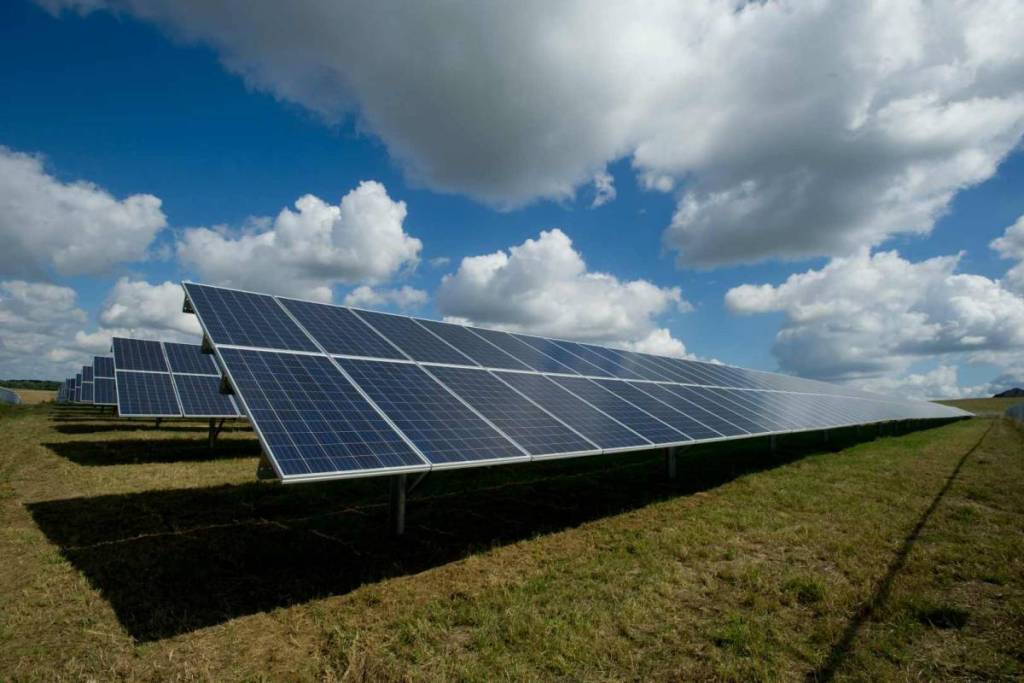

Madrid-Barajas has just added a new piece of infrastructure that’s hard to take in at a glance. Adolfo Suárez Madrid-Barajas Airport has inaugurated the largest photovoltaic farm installed at an airport in Europe: a 120-megawatt plant with approximately 215,000 solar panels.
The facility will generate 242.9 GWh of electricity per year, an amount that Aena estimates is equivalent to the annual consumption of 137 ,000 households. The energy will be used primarily for the airport’s own consumption, as it is one of the largest electricity consumers in the Community of Madrid due to its continuous operations, terminals, security systems, runways, lighting, and associated services.
215,000 panels within the airport grounds
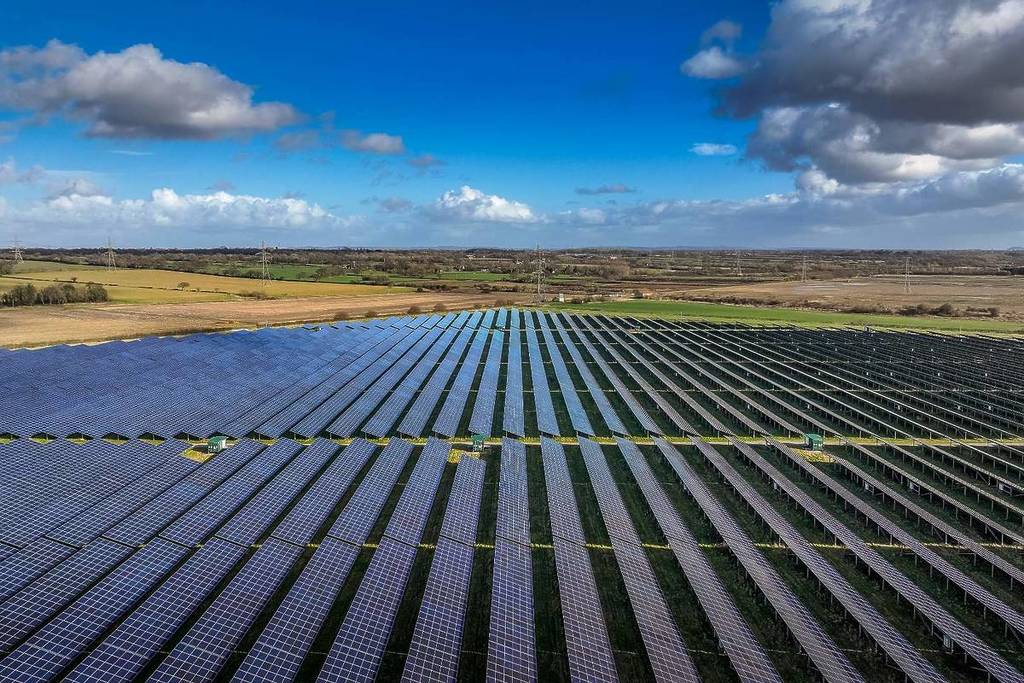
The solar farm does not occupy a single open area visible from a road. Its panels are distributed across different plots within the airport grounds, making use of available land within Barajas without interfering with runway operations or passenger traffic.
The main plant is already operating at full capacity with a rated power of 120 MW and an estimated annual production of 242.9 GWh. Due to its scale, it surpasses any other solar installation integrated into a European airport.
The plant, which covers 140 hectares, is not intended to directly supply nearby homes, but rather to serve as a renewable energy generation facility connected to Barajas’s energy consumption.
A network of three facilities
The newly inaugurated plant is the main component of a larger project. The Madrid-Barajas solar farm will consist of three facilities, and once all are operational, Aena estimates they will be able to produce an amount of energy equivalent to 100% of the airport’s electricity consumption.
The second facility will be a self-consumption plant, with an expected annual production of 11.8 GWh. That energy would be equivalent to 16% of the electricity consumption of Terminals T1, T2, and T3 or the average annual consumption of about 3,600 households.
The third phase is still in the project design phase. It will have a capacity of 45 MW, an estimated annual output of 79.2 GWh, and will cover 41 hectares. Upon completion, the entire complex will feature some 215,000 photovoltaic modules and will be capable of generating enough energy to meet the needs of more than 100,000 households.
The Solar Race Among Airports
The project is part of Aena’s Photovoltaic Plan, which promotes solar installations at twelve airports in its network. The corporate goal is to achieve carbon neutrality by 2026 and move toward the commitment to net-zero emissions by 2030.
The Barajas facility has become the centerpiece of this plan due to the scale of its energy consumption and the space available on the premises. Air travel accounts for between 2% and 3% of global carbon emissions, as Transportation Minister Óscar Puente noted during the project’s presentation.
A new landscape near Madrid
The Barajas solar farm is transforming part of the landscape surrounding the airport. In addition to the airplanes, runways, and major transportation infrastructure, there is now an expanse of photovoltaic modules that makes the site one of the region’s leading sources of renewable energy.
In terms of size, this project should not be confused with other large-scale plants currently being planned in municipalities in the eastern part of the Community of Madrid. BetweenTorres de la Alameda and Villalbilla, for example, there is another photovoltaic project with more than 155,000 panels and a planned area of about 290 hectares—an area roughly equivalent to 400 soccer fields.