
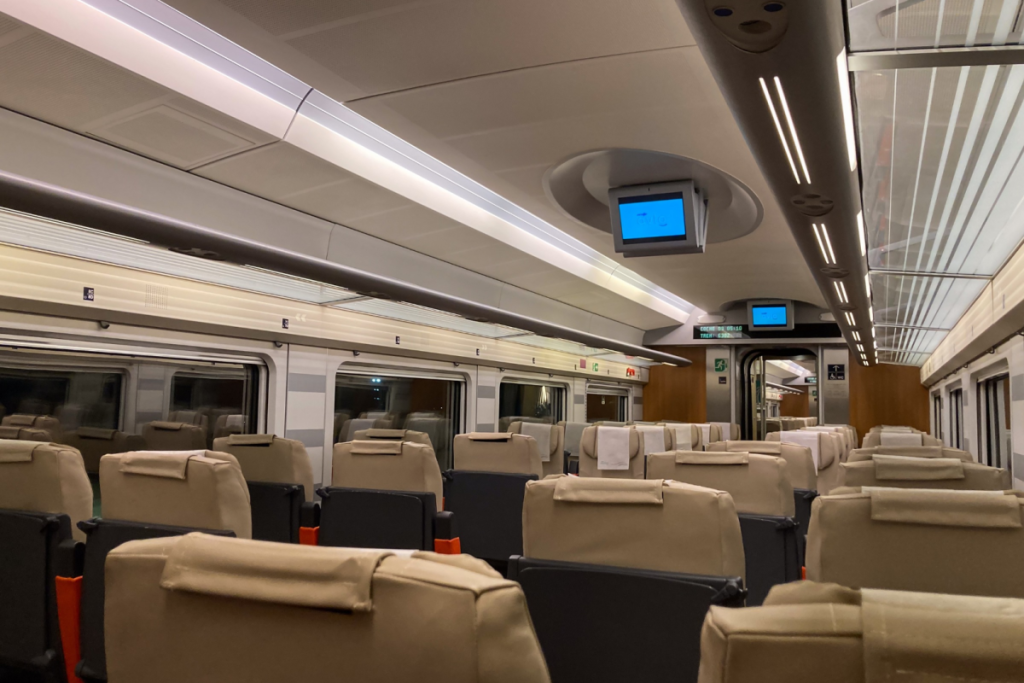

Getting on a high-speed train and not finding a seatbelt can be striking, especially when compared to a car or an airplane, and it’s a common question that arises when major train accidents occur.
However, rail safety does not involve simply adopting solutions from other modes of transportation. The installation of seat belts requires an assessment of whether they reduce the risk for all passengers, not just those who are buckled in. A five-year study by the British rail safety organization RSSB concluded that the systems analyzed did not offer a real safety benefit under the conditions studied. That is why the International Union of Railways (UIC), an organization that develops standards and recommendations, does not mandate the use of this safety system.
One of the key factors lies in seat design. Backrests designed to deform in a controlled manner can absorb some of the energy when a passenger strikes them. In tests with three-point seat belts, similar to those in cars, it was necessary to reinforce the seat structure to withstand the forces. This improved protection for restrained passengers but worsened some outcomes for those traveling without a seat belt who struck the stiffer seatback in front of them. Therefore, adding this device requires a reevaluation of the passenger compartment design.
The researchers also analyzed what would happen in accidents involving severe deformation of the railcars. In certain cases, remaining strapped to the seat could trap a passenger in an area where the survival space has been reduced or destroyed. That risk was factored into the assessment alongside the potential benefit of preventing a person from being thrown from the train. The conclusion does not mean that a seatbelt can never provide protection in a train accident, but rather that its advantages in some scenarios may be offset by the dangers it introduces in others.