
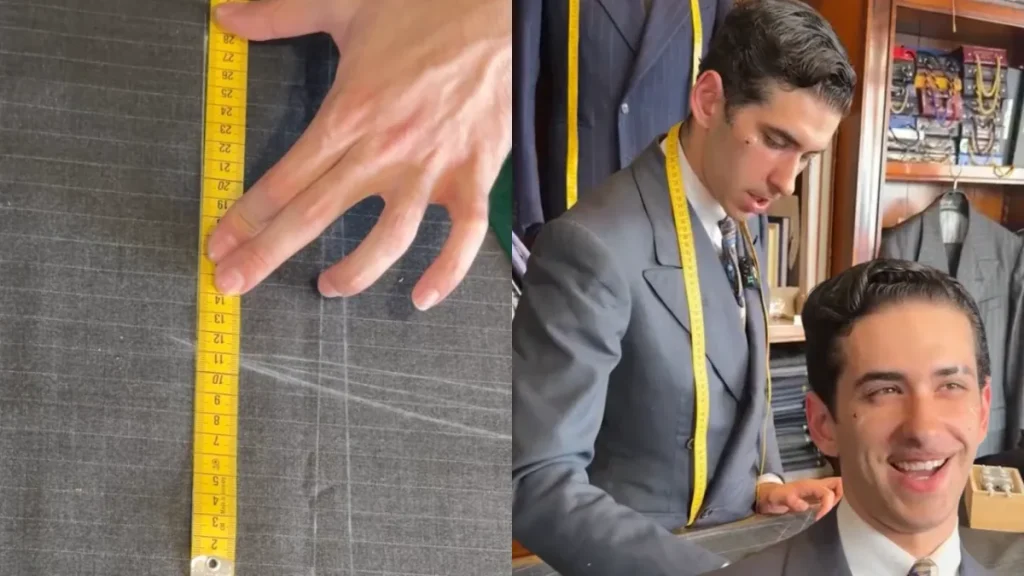

In his workshop in Cuatro Caminos, tailor Mario Vidal cuts and sews by hand the made-to-measure suits he creates for his clients. Far from the office suit—the kind sold off-the-rack, even if it undergoes minor alterations later—Vidal designs for dandies, which he defines as having “swag”: “I don’t have any customers who come to buy a suit just to wear to work,” he says as he shows off his creations.
Vidal, who considers himself Spain’s youngest tailor with his own workshop, began his career in urban fashion design. However, a specific commission introduced him to the world of historical clothing, leading him to create suits inspired by the 17th through 20th centuries. Now that he has perfected the contemporary suit, his goal is to create garments for the 22nd century, seeking a style with a modern silhouette that firmly respects the guiding principles of classic tailoring.
An intensive training program of 16 hours a day
The process of mastering the tailor’s craft usually requires a decade of apprenticeship, but Vidal claims to have completed it in half the time by putting in double shifts of up to 16 hours a day with needle and scissors. His training began at a fashion academy before he moved to Galicia to study under tailor Alejandro Freire. After that period, he returned home, where he spent three years researching patterns online and in old books, and teaching himself to sew.
Later, he settled in Granada to work as a cutter, the first step before enrolling in the Academy of Tailoring. This institution is affiliated with the Asociación de Sastres de la Confianza, Spain’s oldest trade association in the sector, founded in 1865. There, he mastered the technical and physical aspects that govern every cut made on the fabric, gaining the foundation needed to confidently modify patterns and go beyond what traditional manuals dictate.
Mathematics Applied to Fabric
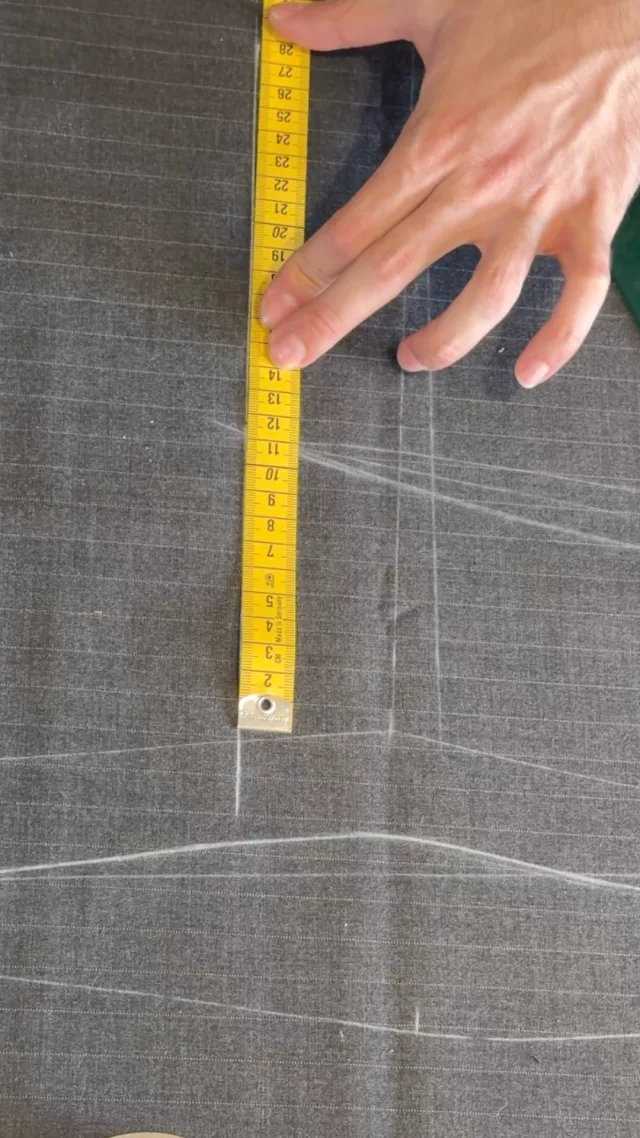
Making a custom-tailored suit demands absolute precision—a task Vidal compares to constantly solving math problems. At the cutting table, the tailor uses rulers and formulas to break down the body’s proportions, calculating measurements based on the chest circumference and adjusting the “drop,” which marks the anatomical difference between the chest and the waist. By maintaining the garment’s exact proportions and classic lines, he ensures that the internal structure functions perfectly, allowing him to experiment with complete freedom in the exterior design.
Despite the technical rigor required by patternmaking, Vidal sets aside time to add handcrafted details that serve no structural purpose in the garments. He incorporates hand-sewn overlock stitching on the inner edges of the pants and hidden decorative topstitching on the jackets simply because he enjoys it, though he acknowledges that he does it “because it fulfills him.” For the tailor, devoting hours to these small, superfluous details is the best way to enjoy his craft and ensure that every piece that leaves the workshop is personally satisfying to him.