
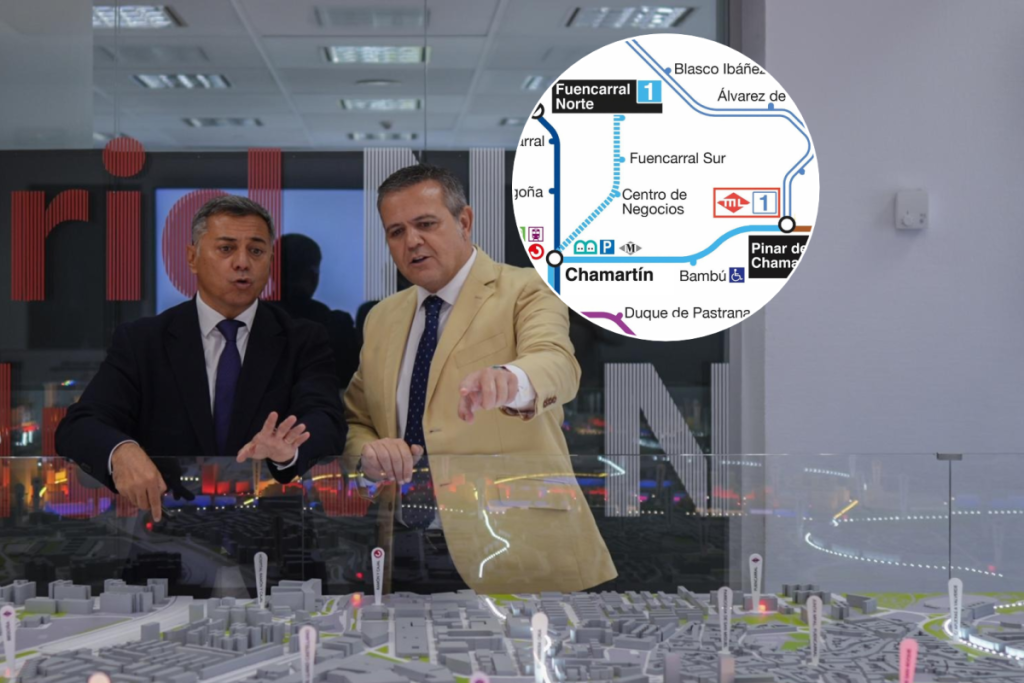

Metro de Madrid Line 1 will be extended to Madrid Nuevo Norte without losing its connection to Pinar de Chamartín. The project includes a “Y”-shaped fork that will allow for two routes: Pinar de Chamartín–Valdecarros and Fuencarral Norte–Valdecarros. In July, the Regional Government presented this solution as the first dual terminus in the subway’s history, although there is a precedent: Line 2 had a branch line between Goya and Diego de León from 1932 to 1958. Therefore, it is more accurate to speak of an unprecedented configuration in the current network rather than the first in its entire history.
The fork will allow trains coming from both northern ends to converge on a shared section toward Valdecarros. In the opposite direction, passengers should pay attention to each train’s destination, as some will continue on to Pinar de Chamartín and others to Fuencarral Norte. This solution addresses the concerns raised by residents during the public consultation: it maintains Line 1’s connection to Pinar de Chamartín and avoids altering the current configuration of Line 4, which will retain its terminus there.
Three new stations on Line 1
The expansion will include three stations with the provisional names Centro de Negocios, Fuencarral Sur, and Fuencarral Norte. The Community has definitively approved the preliminary study and has selected Alternative 5, known as the Somera Alternative for the Extension of Line 1, with an estimated tender budget of approximately 400 million euros. The regional government estimates that the connection will benefit some 175,000 residents and serve the new development, where approximately 10,500 homes are planned.
The construction plans still need to be drafted and approved before work can begin. The regional government has explained that the new layout of Line 1 will not enter service until the Madrid Nuevo Norte urban development project is completed; in the meantime, the current route will continue to operate. For now, the official announcement does not set a definitive opening date nor does it detail the distribution of service frequencies between the two future terminals.