
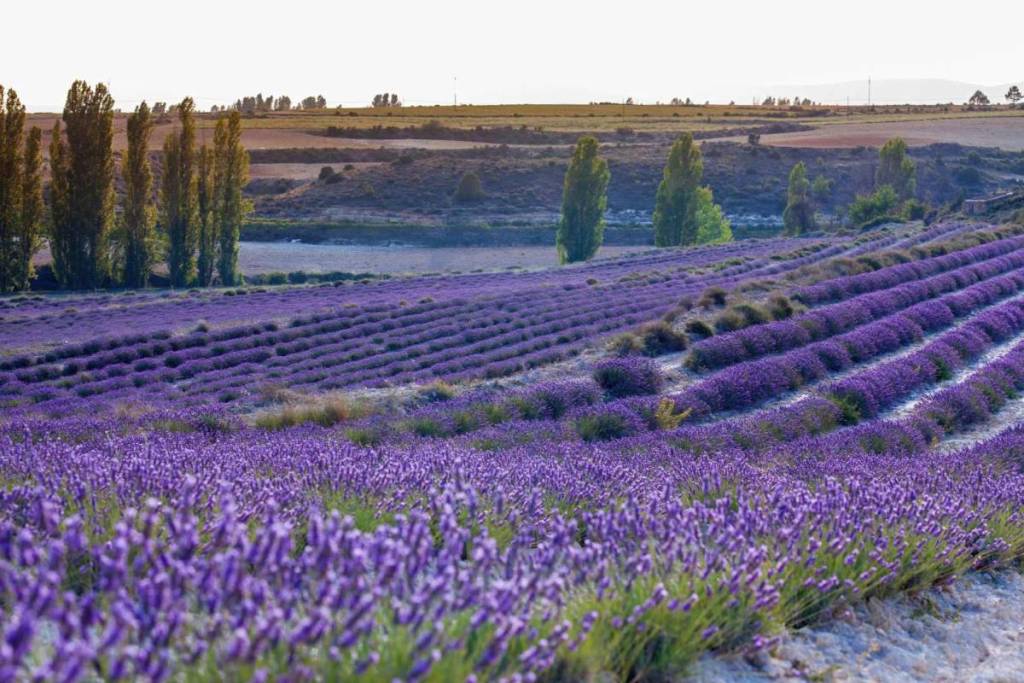

Just over 50 minutes by car from Madrid, right on the border with Guadalajara but still within the Community of Madrid, there is a village with fewer than 1,000 residents that turns purple in the summer. Pezuela de las Torres, in the area known as the Madrid Alcarria, has gone from being an unassuming farming town to one of the region’s most stunning lavender landscapes in just a few years: hundreds of hectares of lavandin nestled among golden hills of wheat, with the village’s silhouette in the background. The curious thing is that, despite the spectacular beauty of its fields, almost no one outside the area knows about it.
To reachPezuela de las Torres, you travel through a golden sea of grain fields until the landscape changes; in July, the hills are covered with purple rows of lavandin, a hybrid of lavender and French lavender. This crop was introduced just five years ago as an initiative by local farmers to diversify the economy and has already become one of the town’s major attractions.
Lavandin is more resilient and productive than traditional lavender; it produces more flowers and lasts longer, making it ideal for industrial uses.
A hidden gem within the Community of Madrid
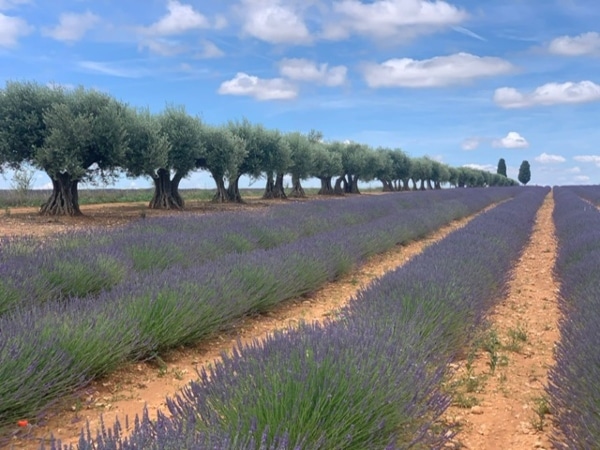
When people talk about lavender fields near Madrid, almost everyone thinks of Brihuega—about 90 kilometers away—and its famous festival. However, just an hour from the capital, you can visit fields that are just as photogenic without leaving the Community of Madrid, thanks to Pedrezuela’s initiative.
The commitment to lavender hasn’t been limited to the landscape. Pezuela de las Torres is the only municipality in the Community of Madrid that has a distillery dedicated to converting lavandin flowers into essential oils for cosmetic, pharmaceutical, and therapeutic uses. The crop not only changes the view; it has also required adapting agricultural machinery, learning new harvesting techniques, and opening up new marketing channels.
These fields have become so significant that, starting in 2024, the town has been hosting its own Lavender Festival, also known as “Aroma de la Alcarria Madrileña.” During the festival, landmarks (such as the Santa Ana Chapel), the distillery, and the fields are open to the public free of charge, with activities ranging from guided tours to music at sunset among the flowers. It’s a much smaller and more local festival than the one in Brihuega, but that’s precisely where its charm lies: less of a massive spectacle, more of a lavender-scented village festival.
The best time to see the fields at their peak is in July, when the lavandin is in full bloom and the contrast between the purple of the lavender and the golden hue of the grain is most intense. During those days, the evening light transforms the landscape into a sort of Provençal dream on a Madrid scale: rows of lavender, the low-hanging sun, and the scent of lavender in the air.