

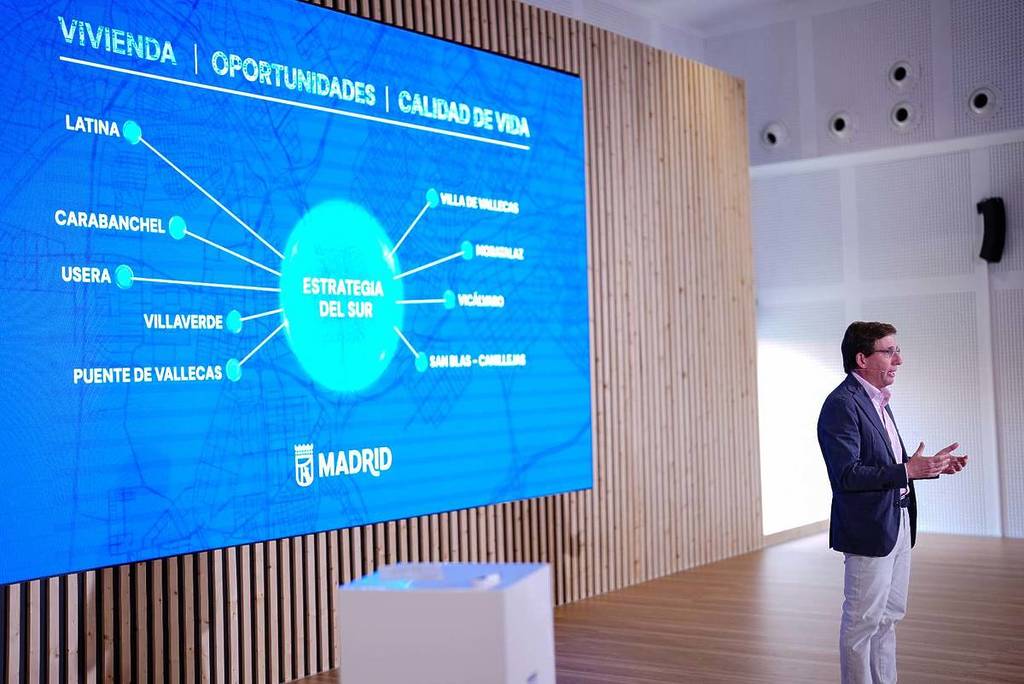
Madrid continues to grow, with no suburb escaping the creation of a new neighborhood, but this expansion is occurring with particular diligence in the southeast of the capital. Yesterday, Mayor José Luis Martínez Almeida presented a new urban center project that imitates or copies what has been learned from Madrid Nuevo Norte. This new reality will affect the districts of Latina, Carabanchel, Usera, Villaverde, Puente de Vallecas, Villa de Vallecas, Moratalaz, Vicálvaro, and San Blas-Canillejas, and its official name is Estretgia del Sur.
The future Madrid Nuevo Sur is planned for the site of the current Adif logistics station in Abroñigal, which the central government plans to move to Vicálvaro. The City Council wants this move to open the door to mixed development with housing, offices, shops, educational and social facilities, sports facilities, and large public spaces, in what Almeida defines as “the gateway to the entire south of the city.” The project is part of the Southern Strategy and will be formally presented to the Cibeles Plenary this month, with the intention of reaching a broad agreement similar to that of Madrid Nuevo Norte and beginning to work with the Ministry of Transport and Adif on the redesign of the railway area.
Although the urban planning details for Abroñigal are yet to be finalized, the mayor and his team have already made clear several key policies, including that it will be a compact neighborhood with a real mix of uses, aligned with the criteria of sustainability and mobility as required by law, and with sufficient density to support a strong network of public services (although in new neighborhoods such as El Cañaveral these are slow to arrive) and a significant stock of affordable housing.
The Southern Strategy: 160,000 homes and 5,600 hectares
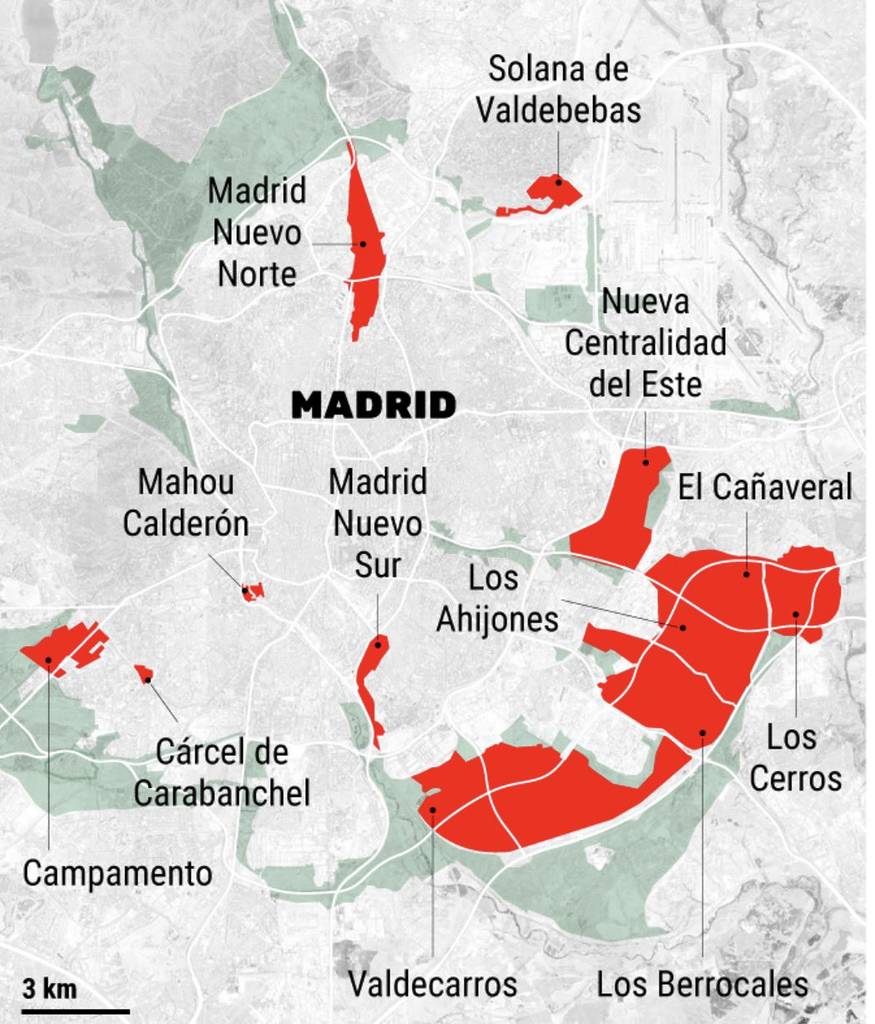
In the residential chapter, the Southern Strategy identifies 5,600 hectares of land with the capacity to build around 160,000 new homes (it is understood that the City Council includes in these figures new neighborhoods already built in the area, such as Los Berrocales), which would be equivalent to about 40% of all the housing planned in the Community of Madrid in the coming years.
Another pillar of the strategy is the regeneration of industrial and productive land to attract businesses and employment. The municipal document cites actions such as the transformation of the land of the former Tubos Borondo factory, the Santa Luisa and Campus Sur areas, the expansion of Mercamadrid, and the creation of the San Eustaquio-Marconi axis in Villaverde, conceived as new hubs of activity that take advantage of the strategic location of the south and its infrastructure network. The commitment to “hybridization of uses,” that is, mixing housing, economic activity, and services in the same urban areas, aims to avoid the mistakes of commuter towns and isolated industrial parks and to build neighborhoods where people can live, work, and consume within a short radius.
At the same time, the quality of life axis combines three lines: improving public transport and sustainable mobility (reinforcing the metro and commuter trains, new connections and cycle corridors, although nothing has been finalized), consolidating a large green belt of around 1,000 hectares connecting existing and new parks, and renaturalizing degraded spaces. The strategy includes the continuation of the Metropolitan Forest, the recovery of the Ambroz Lagoons, the Southwest Green Walk, the Manolito Gafotas park in Carabanchel, and the City of Sports in San Blas-Canillejas, among other actions, with the idea that southern neighborhoods will have access to large interconnected green areas, and not just isolated pocket parks.
An opportunity… and many unknowns
For the City Council, the combination of Madrid Nuevo Sur and the Southern Strategy is “a historic opportunity to unite the city,” stitching together the north and south, currently divided by the M-30 and the railway infrastructure, and positioning the southern districts as protagonists of urban growth rather than a secondary periphery.
But the Abroñigal megaproject also raises questions: from financing and timelines (as it involves Adif land and complex planning that could take more than a decade) to the actual distribution between affordable and free housing, the impact on neighboring neighborhoods, and the risk of replicating gentrification dynamics if the new centrality is too oriented toward the high-end segment. Accounts that analyze what is happening in the city, such as Madrid Decante, have made a critical analysis of how it could affect