
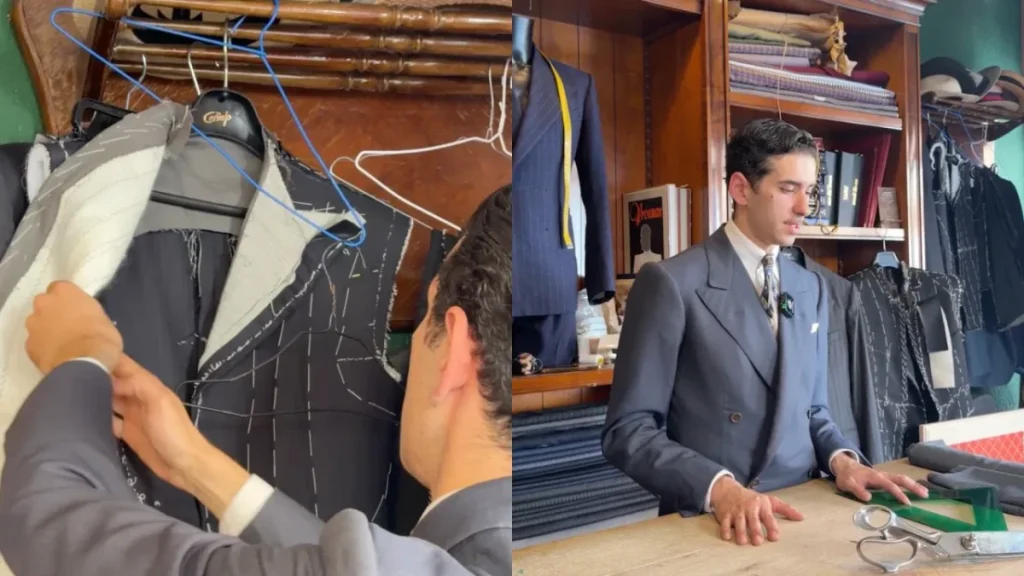

The Asociación de Sastres de la Confianza, founded in 1865 and considered the oldest organization of its kind in Spain still in operation, has experienced a radical shift in demand for its training academy. This was revealed by Spain’s youngest tailor, Mario Vidal, in an interview with Madrid Secreto.
In just a month and a half, the 25 available spots for new students have filled up—a number and speed of enrollment that industry professionals say haven’t been seen in decades. This sudden surge in applications stands in stark contrast to recent years, when the number of students barely reached 16 and the enrollment process took months to complete.
The Technique: Between Lightness and Structure
Mario Vidal also reflects in the interview on the differences between tailoring schools. The Spanish school of tailoring, for example, is distinguished by its pursuit of a very specific technical balance: it aims to create garments that are as well-constructed and structured as British ones, while at the same time achieving a lightness when worn that is comparable to that of Italian tailoring.
Unlike women’s tailoring, where a suit is crafted to follow the natural shape and drape of a woman’s body, in traditional men’s tailoring it is the jacket itself that must shape and define the client’s silhouette. The garment is designed independently to visually define the chest, accentuate the waistline, and give the sides the proper shape.
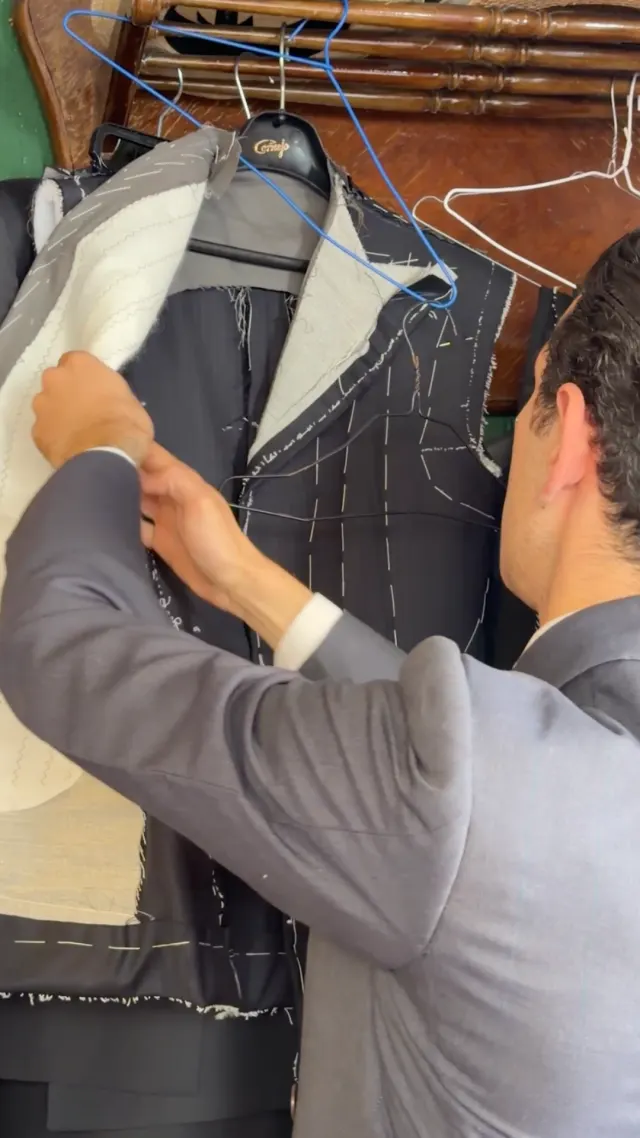
To achieve this structure that is independent of the body, Vidal says, the manual work on the inner interlinings is essential. The construction relies on layering different fabrics that remain hidden. The central piece is the plastrón, located in the chest area, to which the tailor applies strategic darts to create artificial three-dimensional volume. This complex internal system ensures that the jacket retains its shape even when the customer takes it off.
One of the distinctive features of certain techniques in modern tailoring is the tendency to omit the layer of wadding that typically covers the front panel, as well as the occasional use of front panels not made from traditional horsehair. These variations require that the assembly and technique be extremely precise to ensure the suit fits the body correctly.