
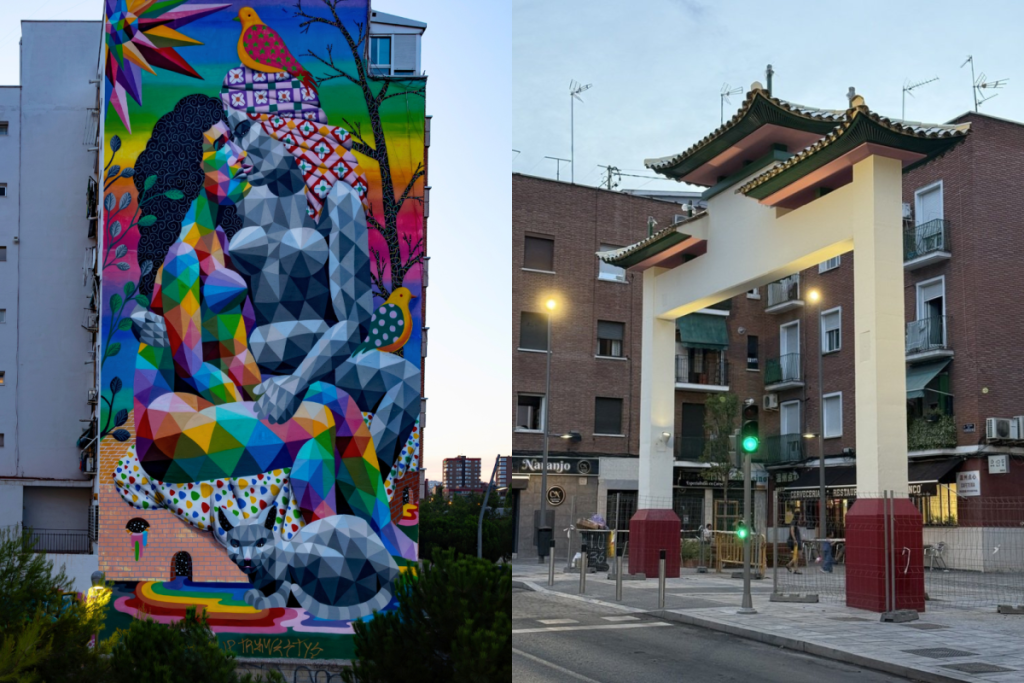

On October 1, Usera will unveil its first Chinese arch, a large monumental gate that will welcome visitors to Madrid’s Chinatown from Plaza del Hidrógeno. The artworkwill be created by Cantabrian artist Okuda San Miguel and will be crowned by a bear—the symbol of the capital—and two dragons representing Chinese culture.
The project is titled “Two Cultures in Love” and will be completed to coincide with the start of Golden Week, one of China’s major holiday weeks, which is celebrated from October 1 to 7. The installation seeks to reinforce Usera’s status as a hub for Chinese culture in Madrid and as a destination for discovering its cuisine, shops, celebrations, and cultural heritage throughout the year.
Madrid’s First Chinese Arch
The structure, known in Chinese tradition as a paifang, stands in Plaza del Hidrógeno, at the end of Usera closest to Madrid Río. This type of archway is commonly used to mark significant spaces, honor a community’s history, or signal the entrance to a neighborhood. In this case, it will serve as a symbolic gateway to Madrid’s Chinatown.
The arch reaches 11 meters in height and nearly 12 meters in width at its widest points. The interior passageway measures eight meters, a scale that will make the structure one of the district’s new visual landmarks and a must-see for anyone exploring the neighborhood.
The base consists of a white concrete portico topped with a metal-framed roof, glazed ceramic tiles, and decorative eaves. The figures designed by Okuda will be installed atop this structure.
A bond between Madrid and China
The central element of the artwork is the encounter between three figures. The dragons allude to Chinese culture, and the bear represents Madrid; rather than appearing to face off against one another, the figures are positioned under the same arch as an image of coexistence, respect, and cultural dialogue.
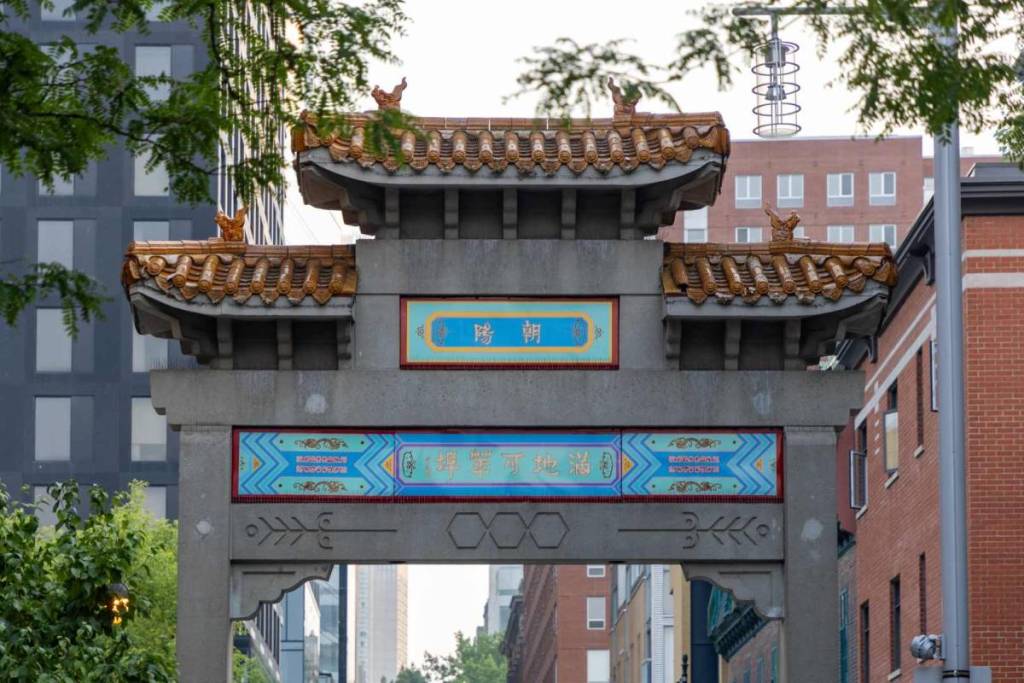
The installation will also include graphics and messages written in Chinese along the portico. Among them is a phrase located on the front of the arch: “The world belongs to everyone,” a principle that refers to the common good, social justice, and coexistence over individual interests.
The result is far from a literal reproduction of traditional Chinese arches. Okuda has reinterpreted the paifang through his own artistic language, known for its geometric compositions, intense colors, and pop-art-style figures. The installation thus combines an element of symbolic Chinese architecture with a contemporary image linked to Madrid’s urban art scene.
A New Icon for Usera
Over the past few decades, Usera has established itself as one of themain hubs of the Chinese community in Madrid. The district is home to a wide range of restaurants, Asian supermarkets, bakeries, specialty shops, and businesses linked to Chinese culture, especially around Dolores Barranco and Nicolás Usera streets. The arrival of the arch adds a new visual landmark to this urban and cultural landscape.
The neighborhood is at its most famous during Chinese New Year, when its streets are filled with parades, lights, food, and activities for people of all ages. However, the new arch seeks to reinforce the neighborhood’s image as a cultural hub and tourist attraction.