
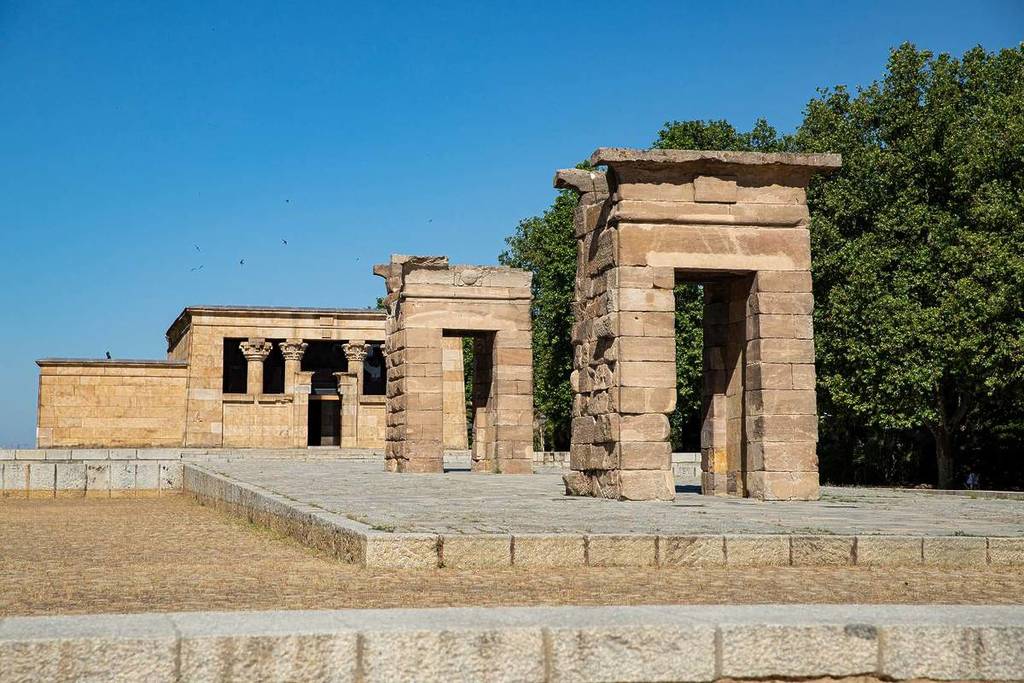

The latest attack on the Temple of Debod has set off alarm bells on social media and among experts, as the stones of its porticos now bear names, initials, scratches, and recent graffiti—a new episode of vandalism against an Egyptian monument over 2,000 years old that the city has preserved outdoors since the 1970s. Images of the damage, shared on social media, have sparked widespread public outrage and reignited a debate that seemed politically settled: Does it make sense to continue leaving a unique piece of the world’s Pharaonic heritage out in the open, exposed to the elements, pollution, and vandalism, or has the time come to protect it with a permanent roof, as is done with similar temples outside Egypt?
In recent days, inscriptions, graffiti, and scratches have been documented on the temple’s original stone, particularly visible on the two large entrance porticos leading to the sanctuary. These are not mere scribbles on railings or modern fixtures, but marks made directly on ancient stone blocks, on which one can read names, initials, and symbols—some made with sharp objects that have scratched the surface.
The images of the deterioration add to a history of warnings: heritage associations and Egyptologists had already been denouncing previous incidents of vandalism, including graffiti, small chips, and marks that, when accumulated, erode the stone alongside the constant effects of rain, wind, frost, and Madrid’s pollution. The temple, donated by Egypt in gratitude for Spanish aid in the rescue of Nubia, was erected in 1972 on a hill in Parque del Oeste, in the open air and without a protective structure—a decision that many today consider unsustainable in the long term.
Why is the debate over covering it resurfacing?
Critical experts point out that most Egyptian temples relocated abroad (such as Dendur in New York or Tafa in Leiden) are displayed indoors, with controlled humidity and temperature, while Debod is the only one of its kind fully exposed to the open air, at an altitude of 650 meters, with sudden changes in weather. In their view, the graffiti and scratches are not an isolated incident, but rather a symptom of structural vulnerability: a millennia-old monument open to the public 24 hours a day, surrounded by meadows and lacking a solid physical barrier between the original stone and any irresponsible hand.
On the other side is the City Council, which has for years defended the decision not to cover the temple. The delegate for Culture, Tourism, and Sports, Marta Rivera de la Cruz, has reiterated that a conservation study conducted between 2019 and 2022 concluded that Debod’s condition was “reasonable” and that there was no risk of immediate destruction of its cultural values, so “covering it is not being considered.” Furthermore, the City Council and the Official College of Architects of Madrid argue that erecting a large glass enclosure or a closed structure would significantly alter the urban landscape (the panoramic view of Parque del Oeste and Casa de Campo) and that part of the stone visible today is modern, brought from Salamanca in the 1970s, and remains in good condition.