

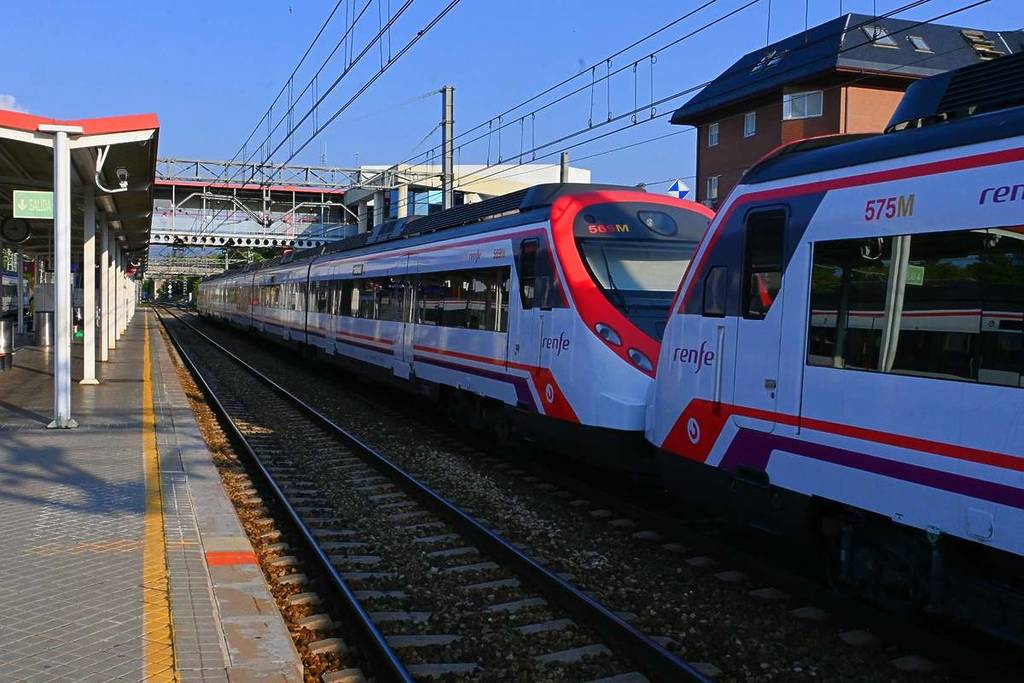
The train buried under Móstoles and Navalcarnero is moving again, at least on paper. Fifteen years after the works were paralyzed and the tunnels were blinded under the urban area, the Ministry of Transport has activated the first formal step to rescue the extension of the C-5 commuter line to Navalcarnero, with a horizon that some sources put at around 2028 if everything fits in terms of deadlines and budgets.
The project was born in 2009 as a great bet of the Community of Madrid: 15 kilometers of new track, seven stations and an awarded cost of 369 million for the Cercanías to reach from Móstoles to Navalcarnero, passing through Arroyomolinos. The works started in 2010 with tunnels drilled under Móstoles and surface structures in Navalcarnero, but the concessionaire OHL stopped the works that same year and the project was judged and abandoned. Since then, kilometers of infrastructure remain under the ground in Móstoles and in sight in Navalcarnero that have never seen a train pass.
In recent days, the Ministry of Transport and Sustainable Mobility, led by Óscar Puente, has decided to take on the initiative and has tendered the feasibility study to complete the connection, something that until now claimed to be resolved by the Community of Madrid. This contract, which includes an analysis of the real state of the executed works, the costs of finishing them and the impact on the mobility of the southwest corridor, is the essential condition to be able to draft a new construction project and seek financing.
The minister explained in X that the study of the extension of the C-5 to Navalcarnero is due to the fact that it is a corridor with “great growth potential” that would benefit some 250,000 people in municipalities such as Arroyomolinos, Sevilla la Nueva, Cenicientos or Navas del Rey, which today depend almost entirely on the car or buses to Móstoles to connect with the rail network.
In order to move forward, the central government has asked the Community for all the technical documentation of the original work and the transfer of the infrastructure already built, which is still owned by the Autonomous Community. The Ministry wants to know precisely what was executed, what degree of deterioration it shows after more than a decade of stoppage and how much it would cost to complete the route to incorporate it into the state network of Cercanías.
Why is there talk of 2028?
Neither the Ministry nor Adif have given an official inauguration date, but the timetable itself allows us to understand why 2028 is being mentioned as a reasonable horizon if there are no new blockages. The timetable would be, broadly speaking:
- 2026-2027: drafting of the feasibility study, on-site inspections, updating of costs and definition of technical alternatives.
- Environmental and administrative approval of the new project and bidding for the completion works.
- 2-3 years of work to complete the platform, stations, railway facilities and rolling stock, taking advantage of what is recoverable from the old work.
In optimistic scenarios, this would place the entry into service around 2028, especially if project and execution phases overlap, but everything will depend on there being no resources, cost overruns or changes in political criteria along the way.
What would it mean for Móstoles, Arroyomolinos and Navalcarnero?
If the buried train is resurrected, the leap for mobility in the southwest would be remarkable. Móstoles would go from being the end of the C-5 to becoming a hub towards Arroyomolinos and Navalcarnero, with four new stations in Mostoleño, one in Arroyomolinos and two in Navalcarnero according to the original design. For the residents, this means being able to reach Atocha or Sol by Cercanías, without having to change buses or take long trips on the A-5 or the R-5, in an area with an ever-growing population.
The commissioning of the corridor will force the reorganization of accesses, park-and-ride lots and bus lines from other surrounding municipalities, which could use the new stations as a gateway to the rail network. And, above all, it would close a symbolic wound: that of an infrastructure buried under Móstoles that for fifteen years has been synonymous with unfulfilled promises and public money buried while waiting for better times.