
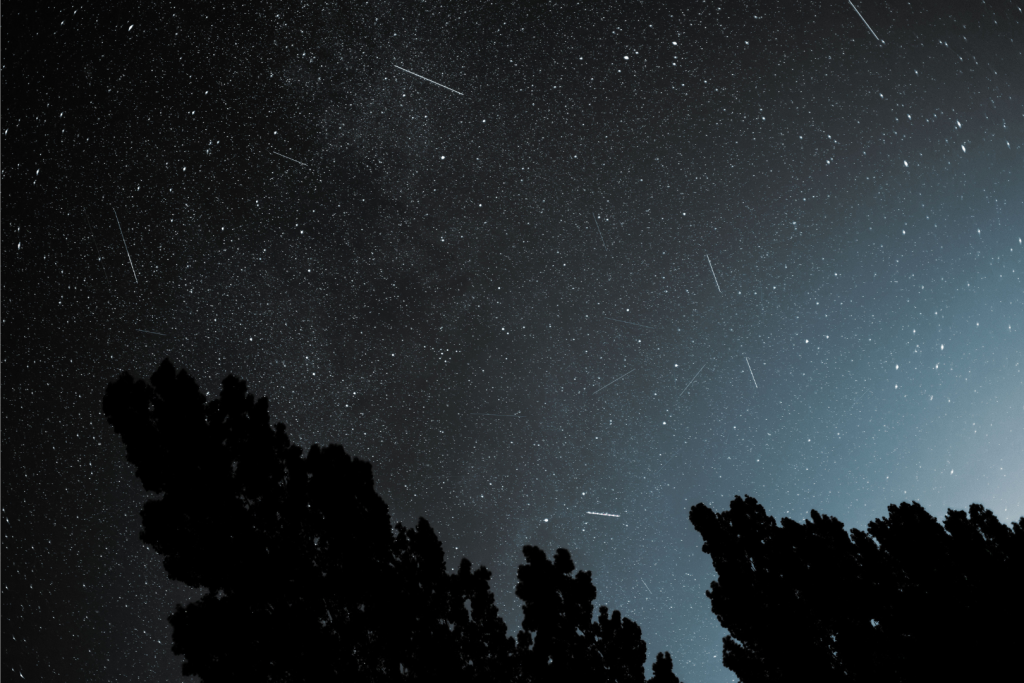

It’s raining in Madrid this week. We’re referring, of course, to the Draconids meteor shower, which will be visible throughout the Northern Hemisphere between October 6 and 10 (that is, between Tuesday and Saturday of this week).
This fall meteor shower is rather modest, with about 20 meteors per hour traveling at a speed of 20 kilometers per second, compared to the Perseids, for example, which at their peak can reach 200 meteors per hour.
Recommended Articles
 A show featuring 500 drones will light up the sky over downtown Madrid: the Christmas lights ceremony kicks off this weekend
 How to Travel from Madrid to Andalusia While High-Speed Service Is Suspended: All Available Options
However, as noted by the National Geographic Institute, there have been years when the Draconids have reached rates of thousands (in 1933 and 1946) or hundreds (in 2011) of meteors per hour.
The explanation is simple: this meteor shower occurs when Earth passes through the ring formed by fragments shed by Comet 21P/Giacobini-Zinner, and the number of visible shooting stars is higher in those years when our planet passes through areas with a higher density of comet debris.
This isn’t expected to happen this year, but there will be one factor that makes the meteors easier to see in the night sky. When the Draconid meteor shower reaches its peak on the night of October 8–9 (specifically, around 3:00 a.m.), the Moon will be nearly new, with only about 5% illumination, and will set just before sunrise, so the sky will be quite dark.
Where to see the Draconids
The radiant of the Draconids (that is, the point from which the shooting stars appear to originate) remains above the horizon throughout the night and is located in the constellation Draco, or the Dragon, between Ursa Major and Ursa Minor. Even so, shooting stars can appear anywhere in the sky, so it’s best to look toward the darkest parts of the sky (away from the Moon).
In Madrid, light pollution makes it quite difficult to see the stars. To best admire the Draconids, it’s best to head out of the capital toward the mountains, to places where artificial light is less intense.