
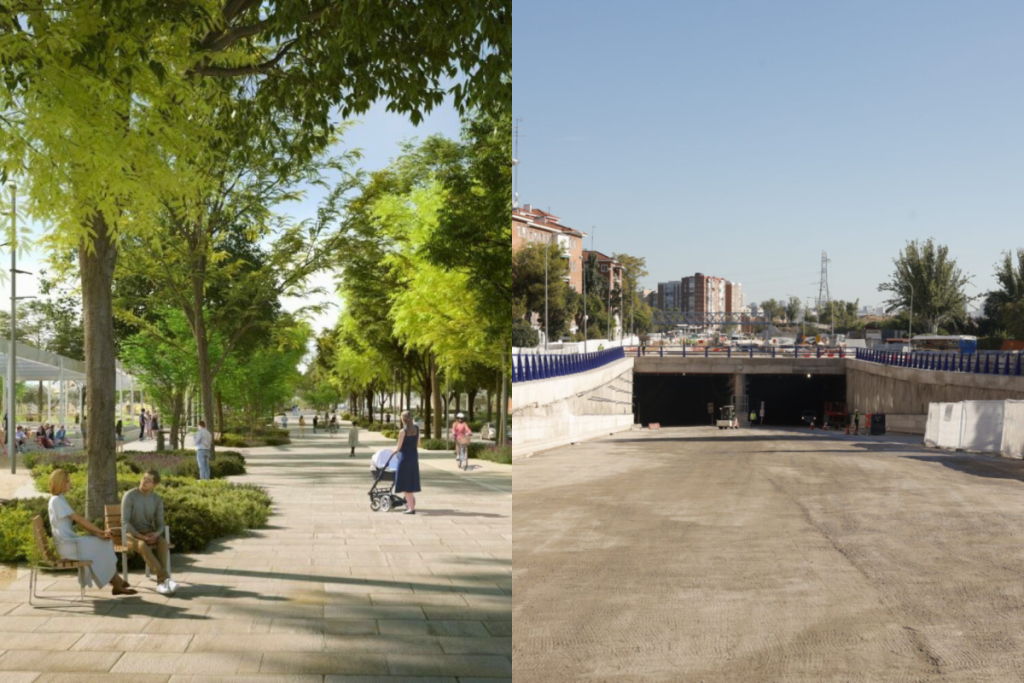

For nearly six decades, the A-5 has been much more than just an entrance to Madrid: it has also served as a divide between neighborhoods. Now, the transformation of the area above the highway is beginning to take shape and promises a new reality for its residents.
The City Council has confirmed that development work is already underway on the Paseo Verde del Suroeste, the corridor that will replace part of the space occupied by the highway and allow life to return to both sides of the road. Work has begun on various sections, while the underground tunnel project continues.
The project spans 3.2 kilometers between Avenida de Portugal and the area around Avenida del Padre Piquer. Along this axis, a landscaped promenade is planned that will extend the pedestrian boulevard of Avenida de Portugal and reclaim approximately 100,000 square meters of space currently occupied by the A-5 and its interchanges. The opening of the tunnel and the completion of the park, however, will be two separate milestones: cars will be able to travel underground before the entire surface development is finished.
A divide between neighborhoods dating back to 1968
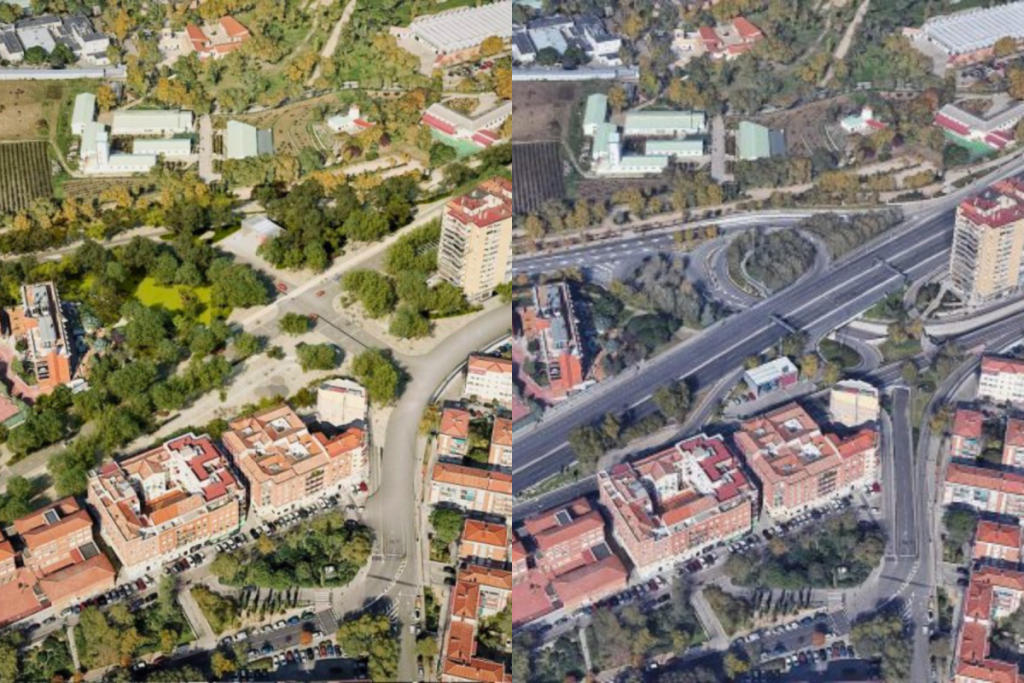
The origins of the separation that is now being addressed date back to 1968. The highway solved the problem of traffic coming from the southern part of the region, connecting major municipalities such as Alcorcón, Móstoles, and Navalcarnero with Madrid, but it left Lucero, Aluche, and Las Águilas—in the Latina district—separated from Campamento, also in Latina, and from Casa de Campo, in Moncloa-Aravaca.
This change now aims to transform an infrastructure designed to channel traffic into a space that also allows people to walk, linger, and move between neighborhoods. Municipal records estimate that some 80,000 vehicles traveled along this route daily—a volume that underscores the highway’s importance both for metropolitan mobility and for daily life in the surrounding area.
Surface construction is already underway
The latest development this October is that the project has visibly entered its urban development phase. Yesterday, the delegate for Urban Planning, Environment, and Mobility, Borja Carabante, confirmed that this work had begun at various points along the 3.2 kilometers of the future promenade. Its implementation is proceeding in parallel with the final stages of the underground tunnel project—which was announced this summer as set to be completed in November but will now be extended until early next year.
This distinction is important for understanding what will unfold in the coming months. Completing the tunnel structure does not mean that gardens, pathways, and pedestrian connections will be ready at the same time. The urban development project has its own timeline and will continue after the underground roadway opens.
The next traffic change will take effect on October 23
As construction progresses, temporary traffic changes will continue. The next change is scheduled for Friday, October 23, when the fork in the lanes exiting Madrid—located near Illescas Street—will be reconfigured. Following this change, vehicles will travel on both sides of the future tunnel entrance.
This is a reorganization of the temporary route linked to the progress of the construction work, not to the opening of the tunnel. The change will allow work to continue at this point while traffic continues to flow on the surface.