
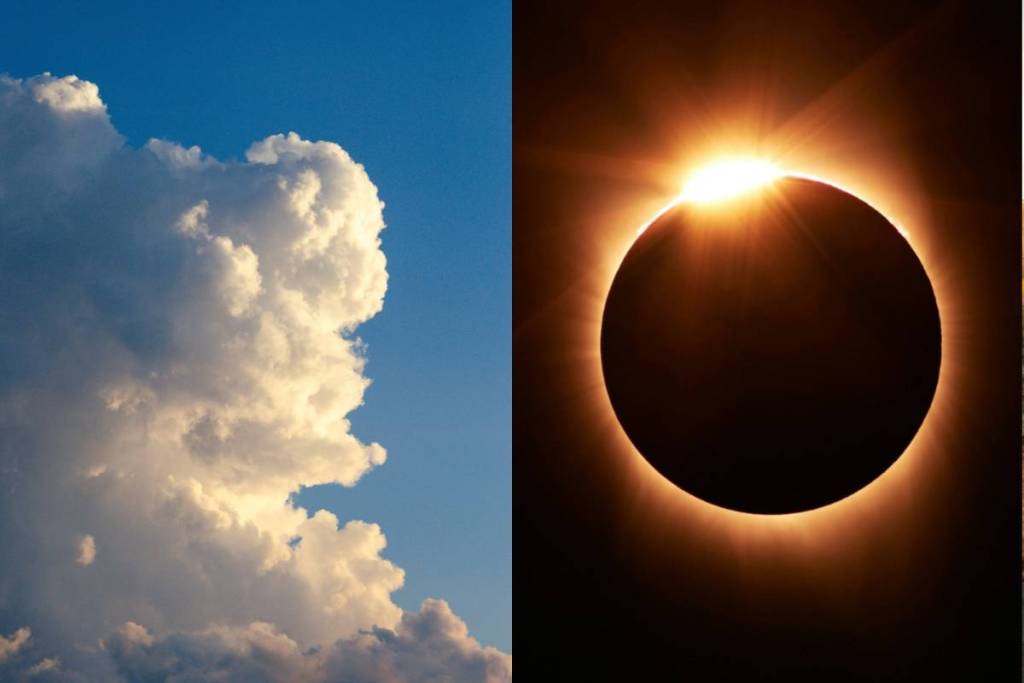

Even with everything prepared for the eclipse on August 12, there are circumstances beyond our control. For example, a mountain might block the sky right in the direction the Sun sets (fortunately, there’s a tool released by the Ministry of Science that can help prevent this). But there’s another, more obvious and unpredictable factor to consider: the weather.
It is difficult, if not impossible, to ensure that a cloud won’t obscure the sun’s disk at the most inopportune moment. It won’t be until a few days before August 12 that the cloud cover forecast can be consulted with any degree of certainty, as the Spanish Meteorological Agency warns.
This means that even if you’ve chosen the perfect spot, have the right glasses ready, and have verified that no building or hill will stand between your observation point and the Sun, you can’t know that far in advance whether atmospheric conditions will allow you to admire the total solar eclipse in all its splendor.
Even so, a study by the AEMET provides a rough idea of which areas of Spain will have the best visibility due to cloud cover during the afternoon hours when the eclipse will occur and on the days around August 12.
The probability that the sky will be clear on the day of the eclipse
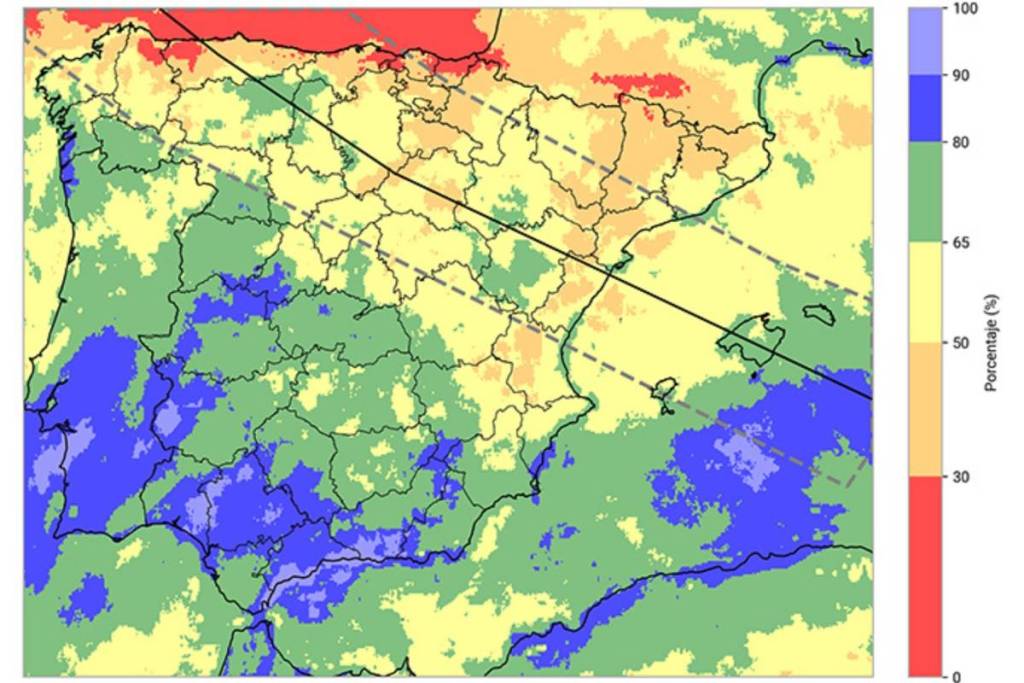
This map, published on the AEMET website, shows the results of the study. It is based on the ERA5 dataset from the European Centre for Medium-Range Weather Forecasts, which provides a reconstruction of past weather conditions based on actual observations. Using this information, it is possible to determine what the atmospheric conditions were throughout Spain over the past few years, between August 11 and 13, from 5:00 p.m. to 8:00 p.m.
After comparing these simulations with cloud cover estimates from weather satellites over a common period of several years, the AEMET has compiled statistics on how often the sky is cloudy or clear on the specified August dates in different regions of Spain.
On the resulting map , areas with a lower probability of clear or partly cloudy skies are shown in yellow, orange, and red. Regions where visibility is likely to be best around the date and time of the eclipse are colored blue or green.
Even so, this is only an estimate; it’s a good idea to keep an eye on the AEMET’s weather forecasts as August 12 approaches to make sure the sky will be clear wherever you plan to view the eclipse.