
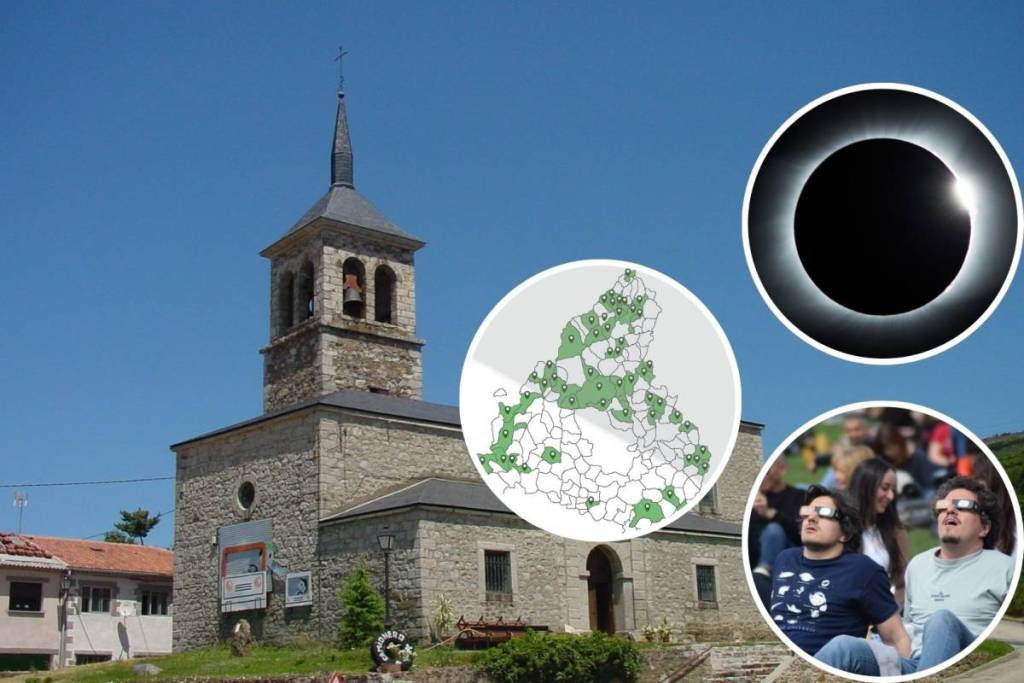

There is exactly one week left to witness the total solar eclipse on Wednesday, August 12. This astronomical phenomenon has not been visible on the Iberian Peninsula for over a century, and although it will be visible from dozens of locations across the Community of Madrid, it will last the longest in a small town in Madrid: Somosierra.
In fact, this is the spot in the region where the Moon’s complete coverage of the Sun will be visible for the longest time: the total phase of the eclipse will be visible for 1 minute and 29 seconds at this point in the Somosierra mountain range.
This prime location, which is one of the 51 observation points designated by the regional government, makes it the ideal destination from which to gaze at the sky on this historic day.
To view it safely, it is also essential to use ISO 12312-2:2015-certified eclipse glasses with a genuine CE mark during the partial phase of the eclipse —that is, while part of the Sun is still visible, even if only minimally—and to avoid looking directly at the Sun’s disk for more than one minute at a time.
Why is it worth watching the eclipse from a place like Somosierra?
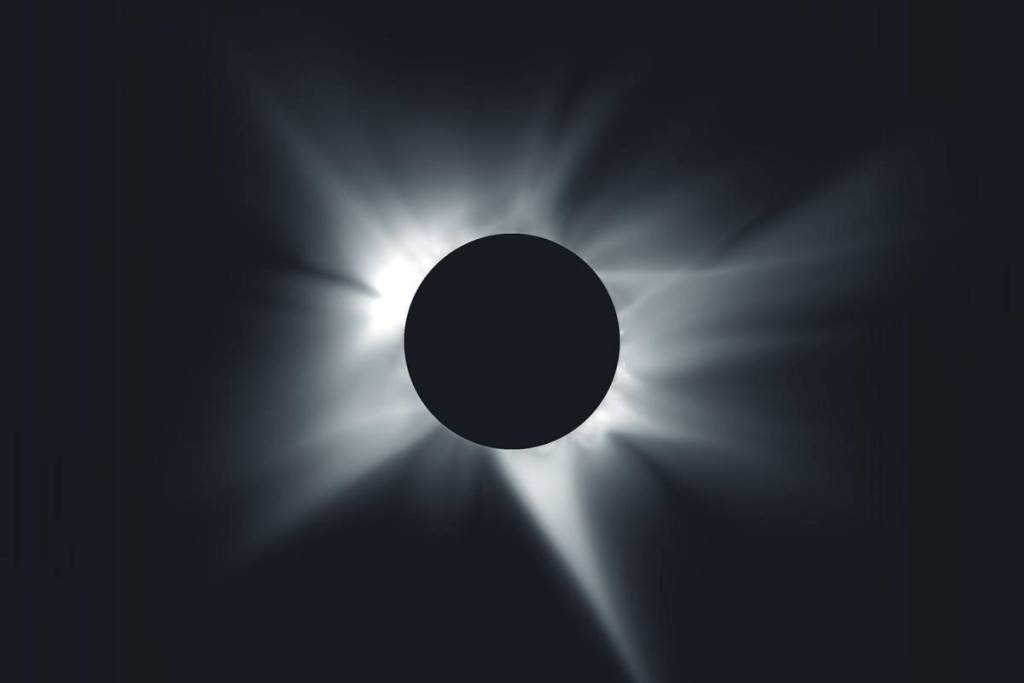
Witnessing an eclipse of this nature from places like Somosierra, where the totality will be visible, has a key advantage: at the exact moment the Moon completely blocks the Sun—and only at that moment—it is possible and recommended to remove your eclipse glasses to appreciate details that would otherwise go unnoticed.
This is the case with the solar corona, the outermost part of the Sun, which is normally invisible because it is obscured by the Sun’s own brightness. The Canary Islands Institute of Astrophysics (IAC)—which is part of the Ministry of Science, Innovation, and Universities (MICIU)—has developed a simulation predicting how it will appear throughout the entire event (shown in the image above).
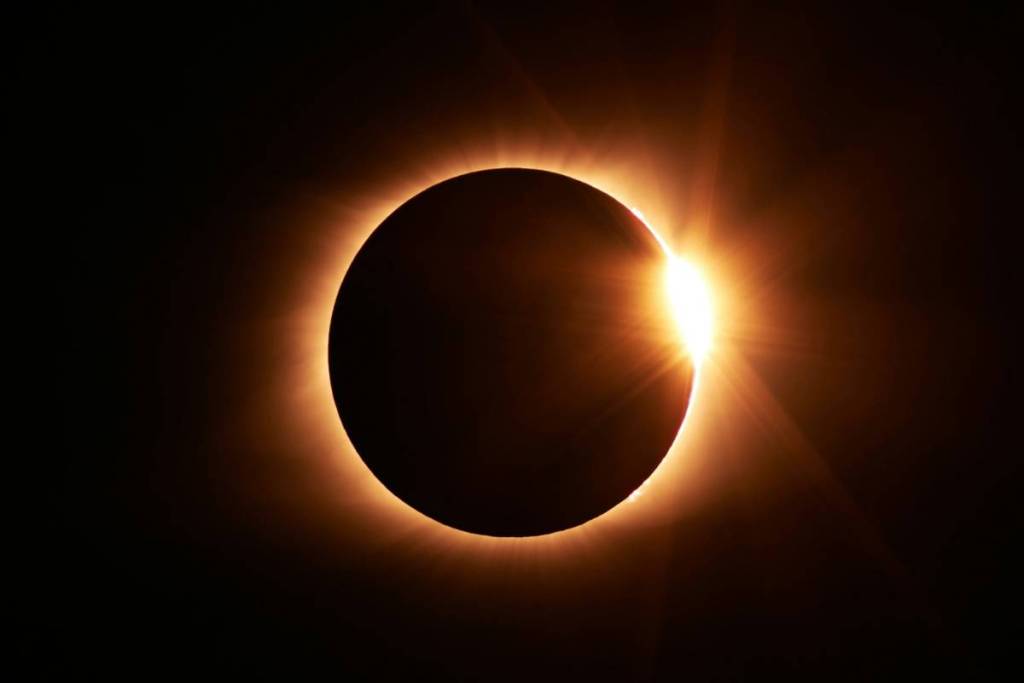
Physicist José Luis Crespo, known on social media as @quantumfracture, summarizes in a video the difference between a partial eclipse and a total one, such as the one in Somosierra: “The Moon fits perfectly over the Sun. The sky darkens abruptly in broad daylight, the temperature drops several degrees, the wind picks up, animals go wild […] and where the Sun was, a black, impossible celestial body appears, surrounded by a white flower [the solar corona]. You don’t get any of this with a partial eclipse.”
For all these reasons, as César González, a science communicator at the Madrid Planetarium, told us in an interview,“It’s worth traveling 100 km to see a total eclipse.” And Somosierra is just 99.2 km from the capital.
How do you get to Somosierra?

To drive from Madrid to Somosierra, the main route is to take the Autovía del Norte (A-1/E-5) toward Burgos, continue to Exit 91 toward the Carretera Irún (N-Ia), and follow the signs to Somosierra.
However, it’s also possible to get there by public transportation on the 191 intercity bus line, which departs from the Plaza Castilla transit hub.
Cities and towns in Madrid within the path of totality
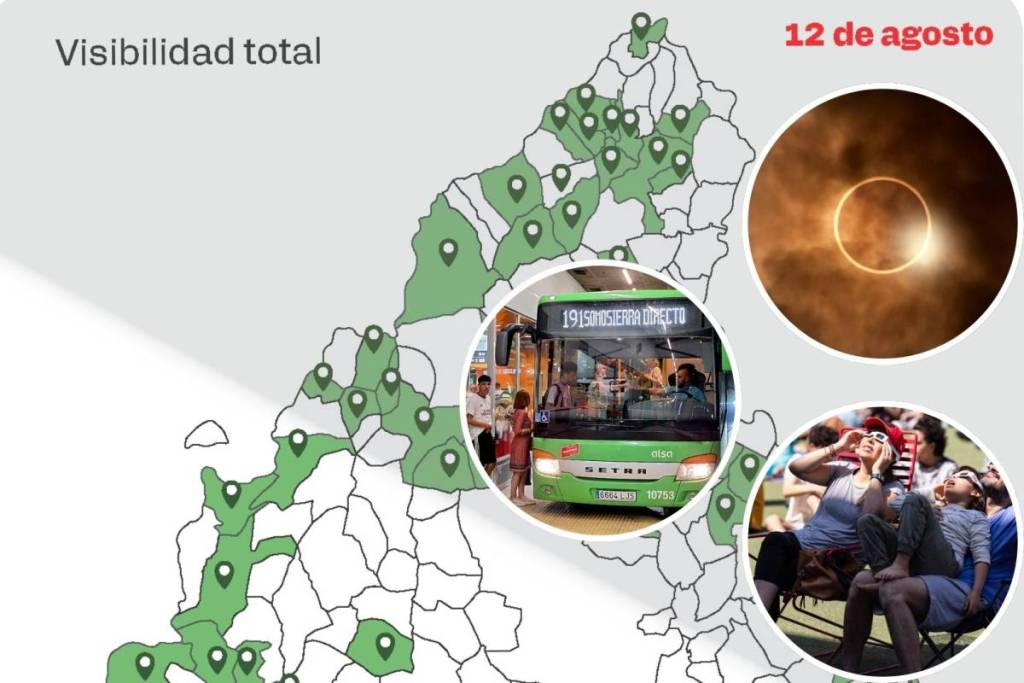
Although Somosierra is the spot in the region where the phenomenon will be visible the longest, there are 40 municipalities and towns in the Community of Madrid that lie within the path of totality, including Prádena del Rincón, Buitrago del Lozoya, Canencia, Rascafría, and El Molar.
In this article, you can find all of these locations and learn how to get there by public transportation.