


Finding a typical Madrid restaurant amid the constant stream of new openings and tourists who flock to any place that looks like a tavern can be quite a challenge. The capital is capable of absorbing almost everything that comes its way and making it its own, and in the process, it’s difficult to preserve the essence of local culture.
Traditional dishes such as tripe and cocido, along with century-old restaurants, are the cornerstone of Madrid’s authentic culinary heritage, which is not only enduring but is even experiencing a resurgence.
Émile Huguenin arrived in Madrid in 1839 and founded Lhardy in the image and likeness of the restaurant that was all the rage in Paris at the time, Café Le Hardi. This iconic restaurant was the city’s first fine-dining establishment, designed to bring together the city’s aristocracy in its dining rooms. The Marquis of Salamanca planned the neighborhood that would bear his name here; the queen brought her lovers here; Primo de Rivera was a regular during his dictatorship; and it was here that Alcalá Zamora was elected president of the Second Republic. As Azorín once said:“One cannot conceive of Madrid without Lhardy.”
Although it was acquired by Pescaderías Coruñesas in 2021, the restaurant is still decorated in the 19th-century style. The signature dish here is Madrid-style cocido, served in two courses; it’s common for the first course (the soup) to contain pieces of meat and chicken, though everyone enjoys it their own way.

Another indisputable witness to Madrid’s history. It was at this spot on Calle Mayor, where Casa Ciriaco is located, that an anarchist attempted to assassinate King Alfonso XIII and Queen Victoria Eugenia of Battenberg as they were returning from their wedding at the Jerónimos Monastery and heading to the Royal Palace. The bomb never reached them, but it did strike the crowd that had gathered to watch the monarchs pass by, killing 24 people.
Despite this tragic event, the restaurant’s significance endures. The intellectual community made it famous ever since Valle-Inclán transformed the tavern into the “Cave of Zarathustra.” Later, a literary salon was established there, presided over by the cartoonist Antonio Mingote until his death in 2012. In fact, you can order the chicken in pepitoria sauce prepared to the cartoonist’s liking; it is one of the signature dishes, along with meatballs and tripe.

We’re continuing on the cocido trail, but if the weather isn’t cooperating, tripe is also a house specialty. At La Bola, the cocido is simmered for over 4 hours over very low heat using oak charcoal.
In addition, they use traditional clay pots here and serve the dish in the same pot in which it is cooked. The raw ingredients—chickpeas, Madrid water, bacon, potatoes, and chorizo—are placed inside the pots and set over charcoal, where they cook for more than four hours; during this time, the pots are periodically refilled with broth.
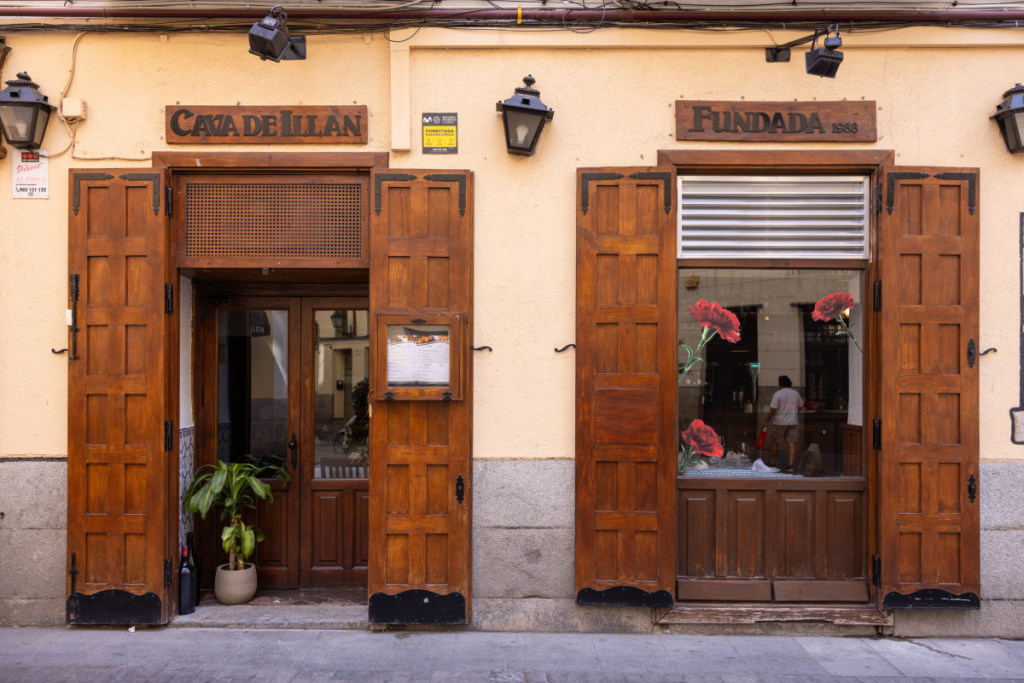
The most authentic side ofLa Latina endures in places like La Cava de Illán, a restaurant serving traditional cuisine and a haven for savoring each dish, sharing conversation, and lingering over the meal. It has two locations in two iconic spots in the neighborhood: Cava Baja and Plaza de la Paja.
The experience goes beyond the table: there’s care, there’s hospitality… and a secret. Impressive stone caves transport us to an underground, cozy Madrid, where the buzz of La Latina fades away , allowing us to focus all our senses on our taste buds: here, tradition is reinterpreted with a unique touch, highlighting dishes such as their freshly sliced meats, oxtail, grilled octopus, Madrid-style tripe, and the celebrated paellas. The latter are prepared with a secret ingredient and finished in the oven to scrape off the socarrat until the paella is gleaming.

Casa Botín is a legend: the world’s oldest restaurant, the king of Habsburg-era Madrid. It has only closed during the pandemic months; it was the first time in three centuries that the century-old restaurant did not serve its customers—it didn’t even stop serving meals during the Civil War.
In 1987, the Guinness Book of World Records named it the oldest restaurant in the world, noting that Goya may have worked there as a dishwasher in 1765.
Its menu offers a good overview of Spanish cuisine, with a special focus on Castilian-style roast suckling pig and lamb, as well as grilled meats.

Another classic Madrid institution is Malacatín. They’ve been preparing Madrid-style cocido since 1895; their motto used to be, “If you finish it, you don’t pay,” and now they even offer home delivery. It’s a fairly small place, so finding a table isn’t easy, but once you do… You’ll indulge in the pleasure of each of the three courses of the cocido, especially the soup, which is quite thick and rich in fat. But if you prefer, they can serve it all together in a single course.

The Café Comercial has long since ceased to be a simple café and has become one of Madrid’s most traditional restaurants. Its leather sofas and marble tables could tell more stories than anyone who has ever passed through there, although little of the original decor remains following the renovation.
It remained open continuously for a whopping 128 years until it was forced to close due to a bureaucratic issue. Its windows were then filled with farewell messages, as if the greatest of rock stars had passed away, but in March 2017 it made a comeback, renovated and with a new “traditional glamour,” in the words of Juan Luis Medina, who oversaw the renovation.

Casa Macareno is a classic Malasaña tavern founded in 1920, where patatas bravas shine on a menu with just the right amount of innovation, and strings of garlic and peppers hang from the walls. Proof that authentic Madrid cuisine is making a comeback is that Rosalía paid a visit after a concert in Madrid and shared the moment on her Instagram.
Surviving in a neighborhood that has undergone such a transformation is no small feat; perhaps the key lies in its daily special and the cocido served on Thursdays during the winter.

If you’re visiting Madrid for the first time—no matter the time of year—one restaurant you absolutely must check off your list is Casa Lucio. You could say that Casa Lucio serves the most famous huevos rotos, not just in Madrid, but in all of Spain.
In fact, the success of this dish transcends borders, having been savored by legends of the small and big screen such as Tommy Lee Jones, Will Smith, and Eva Longoria. The restaurant opened in 1974 and has enjoyed uninterrupted success ever since. Its signature dish can also be enjoyed at La Taberna de los Huevos de Lucio, run by the innkeeper’s children. With a more relaxed atmosphere, its menu offers other varieties such as chistorra, ham, or ratatouille.
Casa Alberto
Since 1827, Madrileños have been coming to this tavern in Las Letras to enjoy a glass of wine and a tapa of cod or tripe. Casa Alberto retains the iconic red façade typical of restaurants that have been open for over a century, along with its sign featuring a black background and gold lettering. Before it opened, this very spot was home to the building where Cervantes wrote the second part of *Don Quixote*, so to commemorate this, there are a few items on display that recall the work and life of this giant of Spanish literature.
Café Gijón

Café Gijón has seen the cream of the “Generation of ’27” pass through its wood-paneled walls; they made the place their meeting spot and forum for debate. The list of famous figures is endless and eclectic—even Mata Hari herself was spotted here. It’s part of modern Spanish history and remains an essential stop for seeing and being seen in the capital.