

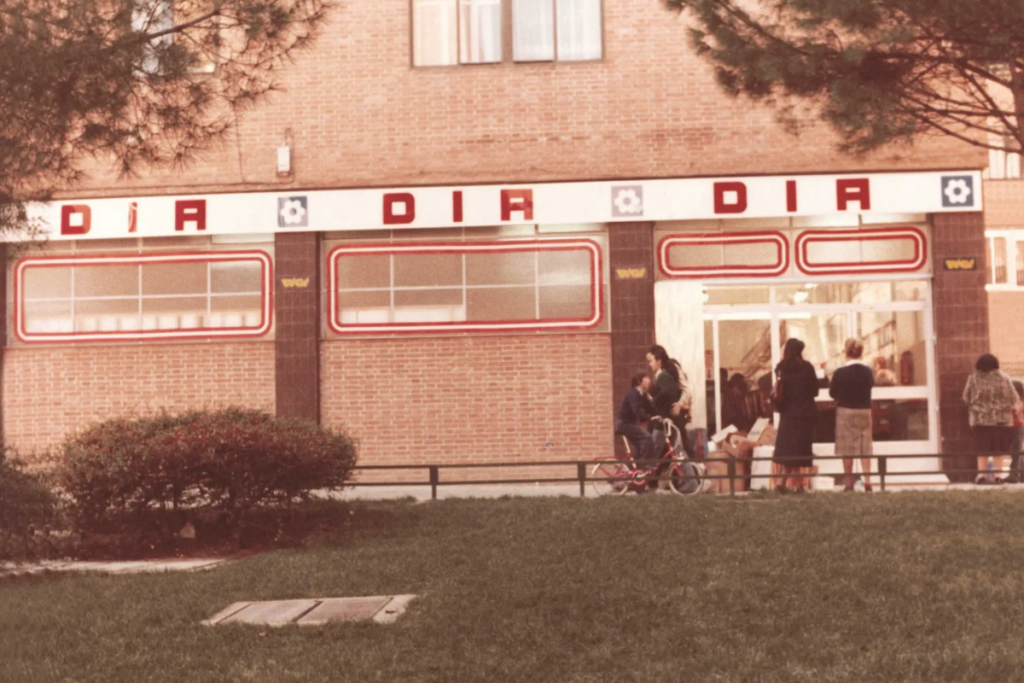
It was 1979 in Spain, with the country having only recently emerged from Franco’s dictatorship. The first general elections following the adoption of the 1978 Constitution had just been held (in March of that same year). Among the many other “firsts” of the Transition, also in 1979 (a few months later, in July), Spain’s first hard-discount supermarket—DIA—opened in Madrid.
Its concept was simple: to serve as a neighborhood discount store where customers could buy a wide variety of products at low prices—a supermarket model that had emerged in Europe after World War II, pioneered by the founders of Aldi.
DIA was also one of the first supermarket chains to offer private-label products in Spain (although Eroski was the first). The chain launched its own brand in 1984. The first product bearing the DIA logo was none other than a bottle of laundry detergent.
But before that (and long before it became a chain with thousands of stores in different countries), DIA supermarkets got their start in a neighborhood store in Madrid’s Moncloa-Aravaca district.
Its first supermarket in Madrid: a store in the Valdezarza neighborhood
Now the chain likes to play with its name on the packaging of its private-label products (see its “Aromas del DIA” coffee shop, or its “InmeDIATto al plato” products); “DIA” originally emerged as an acronym for “Distribuidora Internacional de Alimentación” (International Food Distributor).
At the time, however, it had little international flair; its first store opened at 10 Valderrodrigo Street, in the Saconia residential development, within Madrid’s Valdezarza neighborhood (today, a supermarket belonging to the Unide Market chain).
It wasn’t until 1993 that the chain expanded beyond Spain for the first time, specifically to Portugal, under the “Minipreço” brand. Next came Argentina in 1997 and Brazil in 2001, although this latter international expansion took place after the Dia Group had already been integrated into the Carrefour International Group.
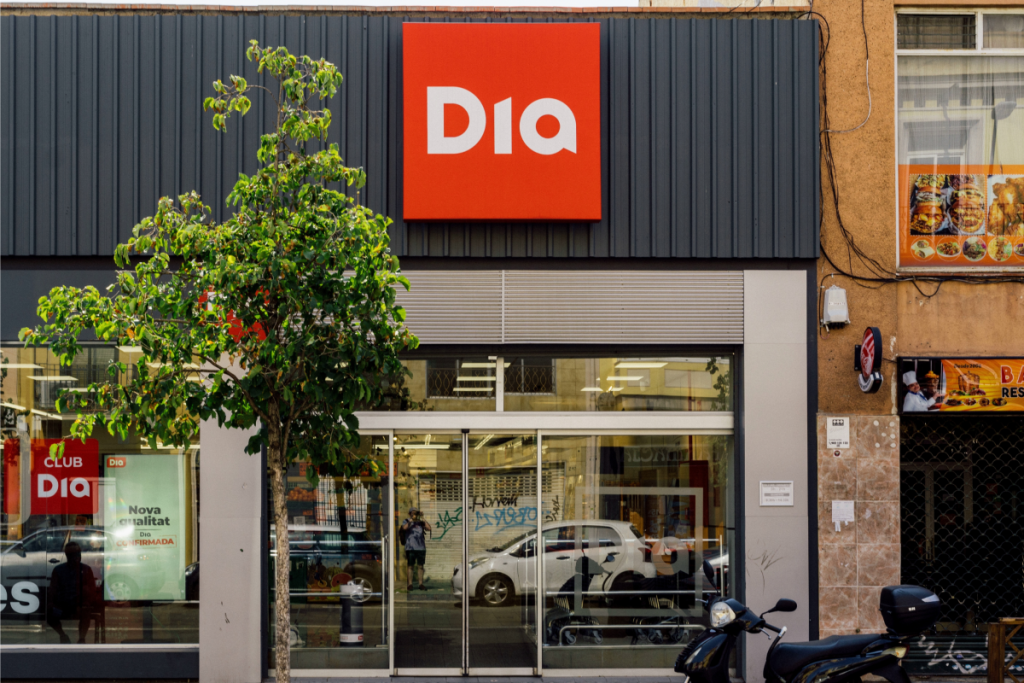
Today, DIA ranks fourth among the supermarket chains with the largest market share in Spain, behind Mercadona, Carrefour, and Lidl, according to the consulting firm Worldpanel by Numerator. It is also, of course, one of the most recognizable brands in the country, with more than 2,400 stores throughout Spain (about 1,600 of which are franchises).