
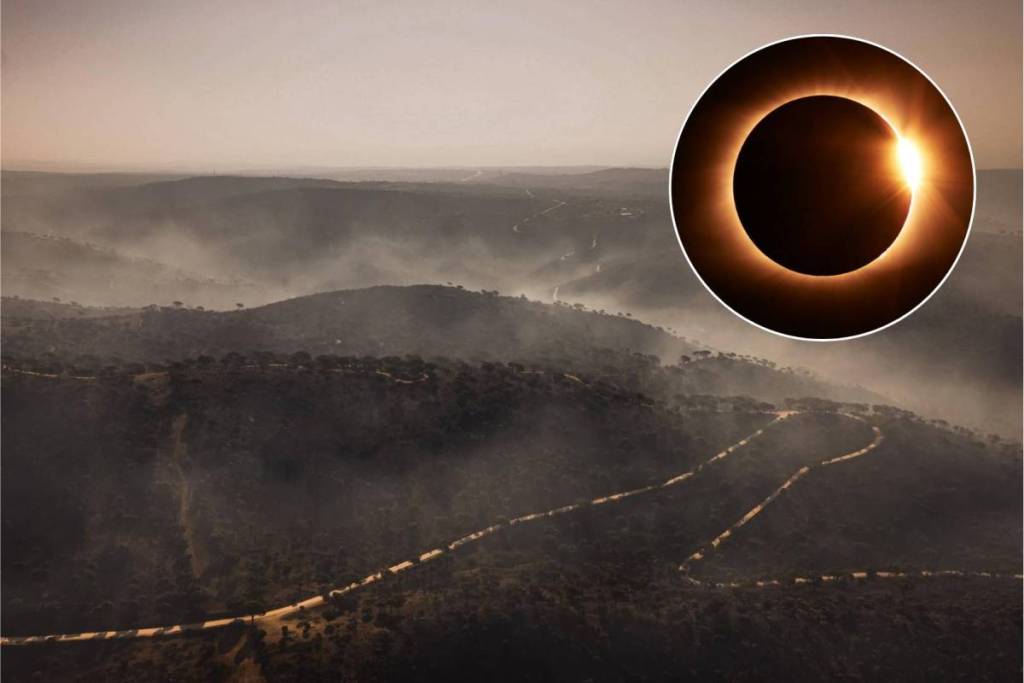

The day of the eclipse is approaching, and thousands of people are expected to travel to areas within the path of totality to witness an astronomical phenomenon that has not occurred in Spain since 1905. The Community of Madrid will set up 52 official viewing sites designed to accommodate the influx of visitors, 17 of which are located in the region’s Sierra Norte.
There, residents are concerned: the risk of wildfires will be “very high or extreme” on August 12, as warned by the AEMET, and there are fears that holding large-scale events near forested areas could result in a catastrophe.
Israel Naveso, spokesperson for the Firefighters’ Union, explained to EL PAÍS that, if it were up to them,“no event posing a fire hazard would be held, especially not after the fire—not only because another fire could break out, but also because, given the large number of people who will be gathering, any incident could increase the risk of accidents.”
In Tres Cantos, an event featuring live music, food trucks, and workshops had been organized at the Valdeloshielos estate, but it was canceled on Monday “due to the risk of wildfires and high temperatures.” Other municipalities, such as Cercedilla, will go ahead with their activities because they are taking place in enclosed areas. Buitrago de Lozoya, where a festival is scheduled to take place— and for which all 3,000 free tickets have already been claimed—is also maintaining its program for the time being.
Despite the high risk of wildfires, only 30 of the 52 municipalities in Madrid with official viewing points have submitted an emergency and evacuation plan and are proceeding with the activities scheduled for August 12. The complete list has not yet been released.
Concern Among Residents of Madrid’s Sierra Norte
On August 5, a rally organized by Monte en Pie took place in Buitrago de Lozoya. Monte en Pie is a platform dedicated to defending the Sierra Norte, created in July following the fire that ravaged 770 hectares in Lozoyuela. At the event , participants demanded the cancellation of events in forested areas, near wooded areas, and dry grasslands. They also called for a“preventionplan” and the deployment of “safety measures” on the day of the eclipse, including forest firefighters.
The platform has asked local governments for information on the emergency response plan scheduled for August 12. Its spokesperson, Ignacio Martínez, explained to EL PAÍS that the responses have been “very ambiguous.”“They haven’t clarified how many personnel they have available, what the response plan entails, or the evacuation routes.”
On its social media accounts, Monte en Pie is asking the public to avoid going into the mountains on their own to view the eclipse: “There is no evacuation or prevention plan in place for the area, so in the event of an emergency, the large influx of people and vehicles would paralyze access routes and hinder the response of emergency services.”
The Association for the Restoration of the Native Forest (ARBA) of the Lozoya Valley has also expressed concern about the impact that the crowds expected on the day of the eclipse will have on the environment .
Like Monte en Pie, ARBA fears the arrival of thousands of people who are unfamiliar with the precautions to take in the mountains and who will wander outside the official viewing areas. Any carelessness poses a risk: a cigarette butt that hasn’t been properly extinguished, a camping stove, or a car parked on dry vegetation could have catastrophic consequences.