

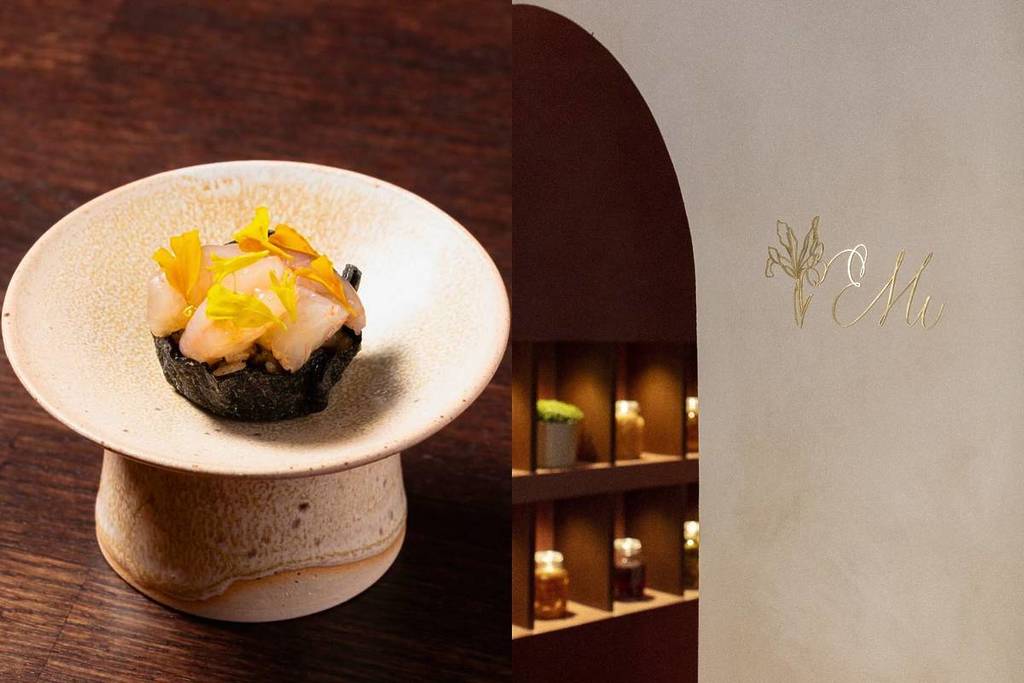
It didn’t even need to be open for a quarter of a year. In just a few weeks, EMi has been recognized by the Michelin Guide as one of the most promising spaces on the Madrid scene. It does so without stars (yet), but with a mention that does not go unnoticed: it is unusual for such a recent project to slip under the radar with such clarity.
Behind this cuisine is Rubén Hernández Mosquero, a chef from Extremadura with an international career that explains, in part, the solidity of the project. But what really distinguishes EMi is not the curriculum, but the conviction with which it is approached: a single tasting menu of 14 courses, without menu or alternatives, which unfolds as a personal, technical and emotional journey.
The space, in the heart of Chamberí, is contained, almost austere. Everything points towards the dish, where ingredients and references from Korea, Denmark, Japan or Extremadura are crossed, like an emotional journey through the kitchens that Rubén Hernández has passed through.
A returning chef, an acclaimed sommelier.
https://www.instagram.com/p/DONzzUBjCdH/?hl=es
Rubén Hernández Mosquero has worked in some of the most influential kitchens in the world: Noma and Geranium in Copenhagen, Atomix in New York, Minibar in Washington, or Azurmendi in Larrabetzu. Now, at the age of 40, he arrives in Madrid with his own project that condenses what he has learned and experienced. EMi’s cuisine doesn’t conform to labels: he uses northern techniques, local ingredients and personal memories to build a gastronomic narrative.
At his side, Miguel Ángel Millán, elected best sommelier in the world in 2024 according to The World’s 50 Best Restaurants, completes the proposal with a wine cellar that does not seek to dazzle but to accompany. His pairings – “Jardín de lirios” and “Un paseo por las nubes”, priced at 150 and 300 euros respectively- aim at the same place as the dishes: balance.
A radically personal proposal
https://www.instagram.com/p/DPQ4UEGjK8E/?hl=es&img_index=1
At EMi there are no stage shows, but there is a careful staging. The menu starts with snacks and ends with petit fours, but what’s in between is harder to define. Names like aebleskiver, takoyaki, gim bugak or stroopwafel appear, but none are there on a whim. Each pass seems to respond to a moment, an experience or a taste that left its mark.
The cuisine speaks several languages, but sounds with its own voice – in fact, the name of the restaurant comes from Emilio, the late brother of Rubén Hernández. And although the menu costs 175 € per person, it does not seem to be conceived as a luxury experience, but as a personal story translated into cuisine. The Michelin Guide has understood it this way, and has underlined it.
Other restaurants recognized by the guide in October

The most recent update of the Michelin Guide has also included three other names that, like EMi, consolidate the particular moment that Madrid’s gastronomy is experiencing outside the big spotlights. At Cornamusa, located in the Palacio de Cibeles, the cuisine is articulated around the seasonal, with a contemporary approach that avoids gimmickry and seeks a balance between tradition and interpretation. A restaurant included in our articles on rooftop restaurants.
In the Salamanca district, El Patio de Claudio, and in Guadarrama, Ruge, complete a small constellation of new entries that look to the territory without losing ambition.